Ch 32: AC Circuits
Knight Calc - Physics for Scientists and Engineers 5th Edition
Knight Calc5th EditionPhysics for Scientists and EngineersISBN: 9780137344796Not the one you use?Change textbook
Chapter 32, Problem 11a

A 20 nF capacitor is connected across an AC generator that produces a peak voltage of 5.0 V. At what frequency f is the peak current 50 mA?

Verified step by step guidance
1
Determine the relationship between the peak current, peak voltage, and capacitive reactance using the formula: I_{peak} = \(\frac{V_{peak}\)}{X_C}, where I_{peak} is the peak current, V_{peak} is the peak voltage, and X_C is the capacitive reactance.
Express the capacitive reactance X_C in terms of the capacitance and frequency using the formula: X_C = \(\frac{1}{2 \pi f C}\), where f is the frequency and C is the capacitance.
Substitute the expression for X_C into the formula for I_{peak}: I_{peak} = V_{peak} \(\cdot\) 2 \(\pi\) f C. Rearrange this equation to solve for the frequency f: f = \(\frac{I_{peak}\)}{2 \(\pi\) V_{peak} C}.
Substitute the given values into the formula: I_{peak} = 50 \(\text{ mA}\) = 50 \(\times\) 10^{-3} \(\text{ A}\), V_{peak} = 5.0 \(\text{ V}\), and C = 20 \(\text{ nF}\) = 20 \(\times\) 10^{-9} \(\text{ F}\).
Simplify the expression to calculate the frequency f. Ensure that all units are consistent (e.g., convert nanofarads to farads and milliamps to amps) before performing the calculation.

Verified video answer for a similar problem:

This video solution was recommended by our tutors as helpful for the problem above.
Was this helpful?

Key Concepts

Here are the essential concepts you must grasp in order to answer the question correctly.

Capacitance

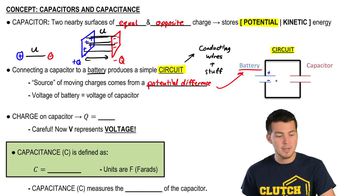
Capacitance is the ability of a capacitor to store electrical charge per unit voltage. It is measured in farads (F), and in this case, the capacitor has a capacitance of 20 nF (nanofarads). The relationship between charge (Q), voltage (V), and capacitance (C) is given by the formula Q = C * V.
Recommended video:
Guided course
08:02
Capacitors & Capacitance (Intro)

AC Circuit and Impedance

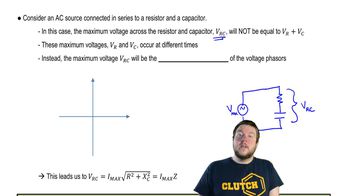
In an AC circuit, the impedance (Z) is the total opposition to current flow, which includes resistance and reactance. For a capacitor, the reactance (Xc) is frequency-dependent and is calculated using the formula Xc = 1 / (2πfC). Understanding impedance is crucial for analyzing how capacitors behave in AC circuits.
Recommended video:
Guided course
08:40
Impedance in AC Circuits

Ohm's Law in AC Circuits

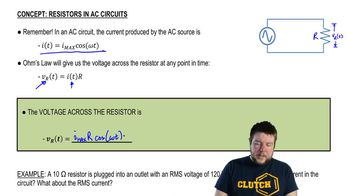
Ohm's Law applies to AC circuits as well, where the peak current (I) can be related to the peak voltage (V) and impedance (Z) by the formula I = V / Z. In this scenario, knowing the peak current and voltage allows us to determine the frequency at which the circuit operates, linking the concepts of capacitance and impedance.
Recommended video:
Guided course
03:12
Resistors in AC Circuits