Ch 32: AC Circuits
Knight Calc - Physics for Scientists and Engineers 5th Edition
Knight Calc5th EditionPhysics for Scientists and EngineersISBN: 9780137344796Not the one you use?Change textbook
Chapter 32, Problem 12a

A capacitor has a peak current of 330 μA when the peak voltage at 250 kHz is 2.2 V. What is the capacitance?

Verified step by step guidance
1
Start by recalling the relationship between the peak current (I₀), the peak voltage (V₀), the angular frequency (ω), and the capacitance (C) for an AC circuit: I₀ = ωC * V₀.
Calculate the angular frequency (ω) using the formula ω = 2πf, where f is the frequency. Here, f = 250 kHz, so substitute this value into the formula.
Rearrange the formula I₀ = ωC * V₀ to solve for the capacitance (C): C = I₀ / (ω * V₀).
Substitute the given values into the formula: I₀ = 330 μA (convert to amperes: 330 × 10⁻⁶ A), V₀ = 2.2 V, and ω (calculated in the previous step).
Simplify the expression to find the capacitance (C). Ensure the units are consistent throughout the calculation.

Verified video answer for a similar problem:

This video solution was recommended by our tutors as helpful for the problem above.
Was this helpful?

Key Concepts

Here are the essential concepts you must grasp in order to answer the question correctly.

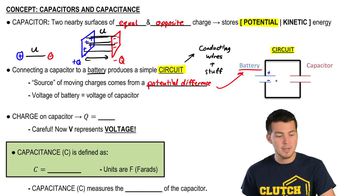
Capacitance

Capacitance is the ability of a capacitor to store electrical charge per unit voltage. It is measured in farads (F) and is defined by the formula C = Q/V, where C is capacitance, Q is the charge stored, and V is the voltage across the capacitor. In AC circuits, capacitance also affects how the capacitor responds to changing voltages.
Recommended video:
Guided course
08:02
Capacitors & Capacitance (Intro)

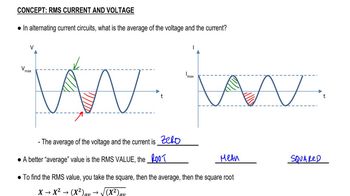
Peak Current and Peak Voltage

Peak current refers to the maximum instantaneous current flowing through a circuit, while peak voltage is the maximum voltage across a component. In the context of capacitors, these values are crucial for determining how the capacitor behaves under alternating current (AC) conditions, particularly at a specific frequency, such as 250 kHz in this case.
Recommended video:
Guided course
07:14
RMS Current and Voltage

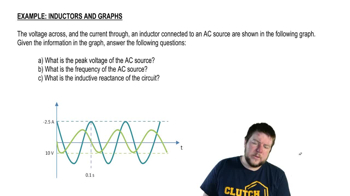
Reactance

Reactance is the opposition that a capacitor or inductor presents to the flow of alternating current due to its capacitance or inductance. For capacitors, the reactance (Xc) can be calculated using the formula Xc = 1/(2πfC), where f is the frequency and C is the capacitance. This relationship is essential for understanding how capacitors influence current and voltage in AC circuits.
Recommended video:
Guided course
03:36
Inductors and Graphs