Ch 32: AC Circuits
Knight Calc - Physics for Scientists and Engineers 5th Edition
Knight Calc5th EditionPhysics for Scientists and EngineersISBN: 9780137344796Not the one you use?Change textbook
Chapter 32, Problem 12b

A capacitor has a peak current of 330 μA when the peak voltage at 250 kHz is 2.2 V. If the peak voltage is held constant, what is the peak current at 500 kHz?

Verified step by step guidance
1
Understand the relationship between the current and frequency in a capacitor. The current through a capacitor is given by the formula: I=VωC, where I is the current, V is the voltage, ω is the angular frequency, and C is the capacitance.
Recall that angular frequency ω is related to the frequency f by the formula: ω=2πf. Therefore, the current is proportional to the frequency when the voltage and capacitance are constant.
Set up the proportionality relationship between the peak currents and frequencies: I2I1=f2f1, where I1 and I2 are the peak currents at frequencies f1 and f2, respectively.
Substitute the given values into the proportionality equation: I2330=500250. Solve for I2 by multiplying both sides by 330 μA.
Conclude that the peak current at 500 kHz is twice the peak current at 250 kHz, as the frequency has doubled. This means I2=2I1.

Verified video answer for a similar problem:

This video solution was recommended by our tutors as helpful for the problem above.
Was this helpful?

Key Concepts

Here are the essential concepts you must grasp in order to answer the question correctly.

Capacitance

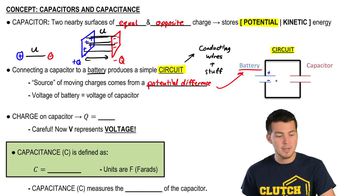
Capacitance is the ability of a capacitor to store electrical charge per unit voltage. It is measured in farads (F) and is defined by the formula C = Q/V, where C is capacitance, Q is charge, and V is voltage. The capacitance value influences how much current can flow through the capacitor at a given frequency.
Recommended video:
Guided course
08:02
Capacitors & Capacitance (Intro)

Impedance in AC Circuits

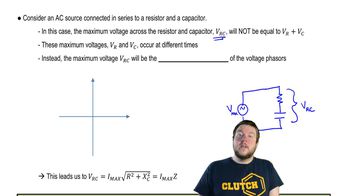
In alternating current (AC) circuits, capacitors exhibit impedance, which is the opposition to current flow. The impedance of a capacitor decreases with increasing frequency, calculated as Z = 1/(2πfC), where Z is impedance, f is frequency, and C is capacitance. This relationship is crucial for understanding how current changes with frequency.
Recommended video:
Guided course
08:40
Impedance in AC Circuits

Current-Frequency Relationship

The peak current through a capacitor in an AC circuit is directly proportional to the frequency of the applied voltage and the capacitance. As frequency increases, the peak current also increases, assuming constant voltage. This relationship can be expressed as I = C * dV/dt, where I is current, C is capacitance, and dV/dt is the rate of change of voltage.
Recommended video:
Guided course
05:08
Circumference, Period, and Frequency in UCM