Ch 32: AC Circuits
Knight Calc - Physics for Scientists and Engineers 5th Edition
Knight Calc5th EditionPhysics for Scientists and EngineersISBN: 9780137344796Not the one you use?Change textbook
Chapter 32, Problem 8b

The peak current to and from a capacitor is 10 mA. What is the peak current if the emf peak voltage is doubled (at the original frequency)?

Verified step by step guidance
1
Understand the relationship between the current and voltage in a capacitor. The current through a capacitor is given by the formula: I=CdV/dt, where I is the current, C is the capacitance, and dV/dt is the rate of change of voltage.
For an AC circuit, the voltage across the capacitor varies sinusoidally, and the current is proportional to the rate of change of this voltage. The peak current is related to the peak voltage by the formula: I=ωCVpeak, where ω is the angular frequency, C is the capacitance, and Vpeak is the peak voltage.
Notice that the peak current is directly proportional to the peak voltage. If the peak voltage is doubled, the peak current will also double, assuming the capacitance and frequency remain constant.
Given that the original peak current is 10 mA, doubling the peak voltage will result in a new peak current that is twice the original value.
Conclude that the new peak current can be calculated by multiplying the original peak current by 2. This step completes the solution conceptually.

Verified video answer for a similar problem:

This video solution was recommended by our tutors as helpful for the problem above.
Was this helpful?

Key Concepts

Here are the essential concepts you must grasp in order to answer the question correctly.

Capacitive Reactance

Capacitive reactance is the opposition that a capacitor offers to alternating current (AC) due to its capacitance. It is inversely proportional to both the frequency of the AC signal and the capacitance value. The formula for capacitive reactance (Xc) is Xc = 1/(2πfC), where f is the frequency and C is the capacitance. Understanding this concept is crucial for analyzing how current and voltage relate in capacitive circuits.
Recommended video:
Guided course
08:02
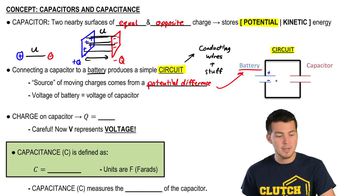
Capacitors & Capacitance (Intro)

Ohm's Law in AC Circuits

Ohm's Law, which states that V = IR, applies to AC circuits as well, but with modifications to account for reactance. In the context of capacitors, the relationship between peak voltage (V) and peak current (I) can be expressed as I = V/Xc. This means that if the peak voltage is doubled while the frequency remains constant, the peak current will also change proportionally, assuming the reactance remains the same.
Recommended video:
Guided course
03:12
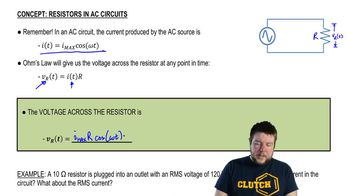
Resistors in AC Circuits

Peak Current and Voltage Relationship

In AC circuits, the peak current and peak voltage are directly related through the impedance of the circuit. For a capacitor, if the peak voltage is increased while keeping the frequency constant, the peak current will increase proportionally, as long as the capacitive reactance does not change. This relationship is essential for predicting how changes in voltage affect current in capacitive systems.
Recommended video:
Guided course
07:14
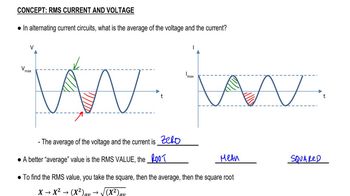
RMS Current and Voltage