Ch 22: Electric Charges and Forces
Knight Calc - Physics for Scientists and Engineers 5th Edition
Knight Calc5th EditionPhysics for Scientists and EngineersISBN: 9780137344796Not the one you use?Change textbook
Chapter 22, Problem 44

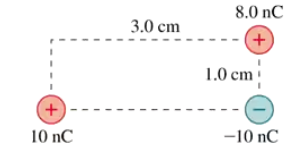
What is the force F on the 8.0 nC charge in FIGURE P22.44? Give your answer as a magnitude and an angle measured cw or ccw (specify which) from the +x-axis.

Verified step by step guidance
1
Identify the charges and their positions in FIGURE P22.44. Note the 8.0 nC charge and the other charges that exert forces on it. Assign coordinates to each charge for clarity.
Use Coulomb's Law to calculate the force between the 8.0 nC charge and each of the other charges. Coulomb's Law is given by: F=kq1q2r2, where k is the Coulomb constant, q1 and q2 are the charges, and r is the distance between them.
Break each force into its x and y components. Use trigonometry to find the components: Fx=Fcosθ and Fy=Fsinθ, where F is the magnitude of the force and θ is the angle relative to the x-axis.
Sum up all the x-components and y-components of the forces to find the net force components: Fx=Fx and Fy=Fy.
Calculate the magnitude of the net force using the Pythagorean theorem: F=Fx2+Fy2. Determine the angle of the net force relative to the +x-axis using: θ=tan-1FyFx. Specify whether the angle is measured clockwise (cw) or counterclockwise (ccw) from the +x-axis.

Verified video answer for a similar problem:

This video solution was recommended by our tutors as helpful for the problem above.
Video duration:
13m
Was this helpful?

Key Concepts

Here are the essential concepts you must grasp in order to answer the question correctly.

Coulomb's Law

Coulomb's Law describes the electrostatic force between two charged objects. It states that the force is directly proportional to the product of the magnitudes of the charges and inversely proportional to the square of the distance between them. This law is fundamental for calculating the force acting on a charge due to other charges in its vicinity.
Recommended video:
Guided course
09:52
Coulomb's Law

Vector Addition

Vector addition is the process of combining two or more vectors to determine a resultant vector. In the context of forces, each force can be represented as a vector with both magnitude and direction. The overall force on a charge is found by adding the individual force vectors, taking into account their directions, which can be expressed in terms of angles.
Recommended video:
Guided course
07:30
Vector Addition By Components

Coordinate System

A coordinate system provides a framework for specifying the position and direction of forces in a two-dimensional plane. In this problem, the +x-axis is typically used as a reference for measuring angles. Understanding how to convert forces into components along the x and y axes is crucial for accurately determining the magnitude and direction of the resultant force on the charge.
Recommended video:
Guided course
05:17
Coordinates of Center of Mass of 4 objects