Ch 22: Electric Charges and Forces
Knight Calc - Physics for Scientists and Engineers 5th Edition
Knight Calc5th EditionPhysics for Scientists and EngineersISBN: 9780137344796Not the one you use?Change textbook
Chapter 22, Problem 52

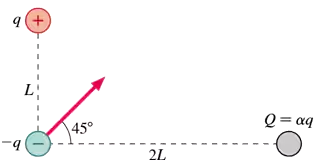
FIGURE P22.52 shows three charges and the net force on charge −q. Charge Q is some multiple α of q. What is α?
Diagram showing three charges: +q, -q, and Q=αq, with net force vector on -q at a 45° angle.

Verified step by step guidance
1
Step 1: Analyze the problem setup. The figure shows three charges: −q, Q, and another charge. The net force on charge −q is given, and we need to determine the value of α, which represents the ratio of Q to q (i.e., Q = αq). Start by identifying the forces acting on −q due to the other charges.
Step 2: Use Coulomb's law to express the forces between charges. Coulomb's law states that the magnitude of the force between two charges is given by: F=kqQr2, where k is Coulomb's constant, q and Q are the charges, and r is the distance between them.
Step 3: Break down the forces into components. Since the net force on −q is given, the forces due to the other charges must combine vectorially to produce this net force. Write the force vectors acting on −q due to Q and the other charge, considering their magnitudes and directions.
Step 4: Set up equations for the net force. The net force is the vector sum of the individual forces acting on −q. Use trigonometry or geometry to resolve the forces into components and equate the sum of these components to the given net force.
Step 5: Solve for α. Substitute Q = αq into the equations and solve for α algebraically. This will involve simplifying the expressions and isolating α to determine its value in terms of the given quantities.

Verified video answer for a similar problem:

This video solution was recommended by our tutors as helpful for the problem above.
Was this helpful?

Key Concepts

Here are the essential concepts you must grasp in order to answer the question correctly.

Coulomb's Law

Coulomb's Law describes the electrostatic force between two charged objects. It states that the force is directly proportional to the product of the magnitudes of the charges and inversely proportional to the square of the distance between them. This fundamental principle is essential for calculating the forces acting on charges in a system.
Recommended video:
Guided course
09:52
Coulomb's Law

Superposition Principle

The Superposition Principle in electrostatics states that the total force acting on a charge due to multiple other charges is the vector sum of the individual forces exerted by each charge. This principle allows us to analyze complex charge configurations by breaking them down into simpler interactions, making it crucial for solving problems involving multiple charges.
Recommended video:
Guided course
03:32
Superposition of Sinusoidal Wave Functions

Net Force

The net force on a charge is the vector sum of all the forces acting on it. In the context of electrostatics, this includes forces from other charges in the vicinity. Understanding how to calculate the net force is vital for determining the conditions under which a charge will remain in equilibrium or move, which is central to solving the given problem.
Recommended video:
Guided course
06:28
Finding Net Forces in 2D Gravitation