
Textbook Question
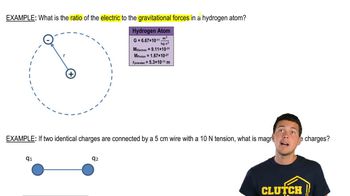
In a simple model of the hydrogen atom, the electron moves in a circular orbit of radius 0.053 nm around a stationary proton. How many revolutions per second does the electron make?
1
views

 Verified step by step guidance
 09:52
09:52
 07:30
07:30 03:32
03:32In a simple model of the hydrogen atom, the electron moves in a circular orbit of radius 0.053 nm around a stationary proton. How many revolutions per second does the electron make?
FIGURE P22.52 shows three charges and the net force on charge −q. Charge Q is some multiple α of q. What is α?
A +2.0 nC charge is at the origin and a −4.0 nC charge is at x = 1.0 cm. Would the net force be zero for an electron placed at the same position? Explain.
A 3.00-cm-long spring has a small plastic bead glued to each end. Charging each bead to −25 nC expands the spring by 0.50 cm. What is the value of the spring constant?
What is the force F on the 8.0 nC charge in FIGURE P22.44? Give your answer as a magnitude and an angle measured cw or ccw (specify which) from the +x-axis.
Objects A and B are both positively charged. Both have a mass of 100 g, but A has twice the charge of B. When A and B are placed 10 cm apart, B experiences an electric force of 0.45 N. What is the charge on A?