
Textbook Question
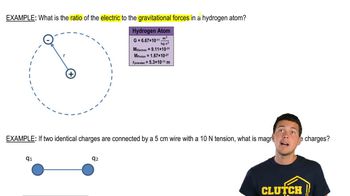
In a simple model of the hydrogen atom, the electron moves in a circular orbit of radius 0.053 nm around a stationary proton. How many revolutions per second does the electron make?
1
views

 Verified step by step guidance
 09:52
09:52
 03:32
03:32 03:16
03:16In a simple model of the hydrogen atom, the electron moves in a circular orbit of radius 0.053 nm around a stationary proton. How many revolutions per second does the electron make?
FIGURE P22.52 shows three charges and the net force on charge −q. Charge Q is some multiple α of q. What is α?
What is the force F on the 1.0 nC charge at the bottom in FIGURE P22.47? Give your answer in component form.
You have two small, 2.0 g balls that have been given equal but opposite charges, but you don't know the magnitude of the charge. To find out, you place the balls distance apart on a slippery horizontal surface, release them, and use a motion detector to measure the initial acceleration of one of the balls toward the other. After repeating this for several different separation distances, your data are shown below. Use an appropriate graph of the data to determine the magnitude of the charge.
What is the force F on the 8.0 nC charge in FIGURE P22.44? Give your answer as a magnitude and an angle measured cw or ccw (specify which) from the +x-axis.
Objects A and B are both positively charged. Both have a mass of 100 g, but A has twice the charge of B. When A and B are placed 10 cm apart, B experiences an electric force of 0.45 N. What is the charge on A?