Ch 20: The Micro/Macro Connection
Knight Calc - Physics for Scientists and Engineers 5th Edition
Knight Calc5th EditionPhysics for Scientists and EngineersISBN: 9780137344796Not the one you use?Change textbook
Chapter 20, Problem 8

Eleven molecules have speeds 15, 16, 17, …, 25 m/s. Calculate (a) vavg and (b) vrms.

Verified step by step guidance
1
Step 1: Understand the problem. You are tasked with calculating two quantities: (a) the average speed (vₐᵥ₉) and (b) the root mean square speed (vᵣₘₛ) for a set of eleven molecules with speeds ranging from 15 m/s to 25 m/s.
Step 2: To calculate vₐᵥ₉, use the formula for the average speed: vₐᵥ₉ = (Σvᵢ)/N, where Σvᵢ is the sum of all speeds and N is the total number of molecules. Add the speeds (15, 16, 17, ..., 25) and divide by 11.
Step 3: To calculate vᵣₘₛ, use the formula for the root mean square speed: vᵣₘₛ = √((Σvᵢ²)/N), where Σvᵢ² is the sum of the squares of all speeds and N is the total number of molecules. Square each speed (15², 16², ..., 25²), sum them, divide by 11, and take the square root.
Step 4: Perform the summation for both calculations. For vₐᵥ₉, sum the speeds directly. For vᵣₘₛ, sum the squares of the speeds. Ensure you keep track of each step to avoid errors.
Step 5: Once the summations are complete, substitute the values into the respective formulas for vₐᵥ₉ and vᵣₘₛ. Simplify the expressions to find the numerical results for both quantities.

Verified video answer for a similar problem:

This video solution was recommended by our tutors as helpful for the problem above.
Video duration:
6m
Was this helpful?

Key Concepts

Here are the essential concepts you must grasp in order to answer the question correctly.

Average Speed (vₐᵥ₉)

Average speed is calculated by taking the total distance traveled divided by the total time taken. In the context of molecules, it can also be determined by summing the individual speeds of the molecules and dividing by the number of molecules. This provides a measure of the central tendency of the speeds in the group.
Recommended video:
Guided course
05:44
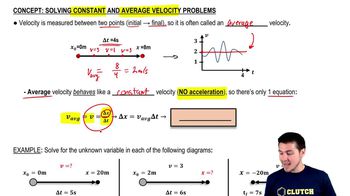
Solving Constant and Average Velocity Problems

Root Mean Square Speed (vᵣₘₛ)

Root mean square speed is a statistical measure of the speed of particles in a gas. It is calculated by taking the square root of the average of the squares of the individual speeds. This concept is particularly useful in kinetic theory, as it relates to the temperature and energy of the gas molecules.
Recommended video:
Guided course
05:21
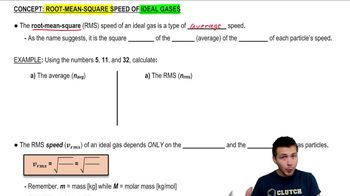
Root-Mean-Square Speed of Ideal Gases

Kinetic Theory of Gases

The kinetic theory of gases explains the behavior of gases in terms of the motion of their molecules. It posits that gas molecules are in constant random motion and that their speeds contribute to the pressure and temperature of the gas. Understanding this theory is essential for interpreting the significance of average and root mean square speeds in the context of molecular motion.
Recommended video:
Guided course
01:50
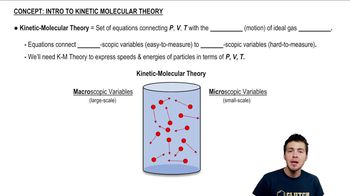
Introduction to Kinetic-Molecular Theory
Related Practice
Textbook Question

A cylinder of nitrogen and a cylinder of neon are at the same temperature and pressure. The mean free path of a nitrogen molecule is 150 nm. What is the mean free path of a neon atom?

Textbook Question

At 100℃ the rms speed of nitrogen molecules is 576 m/s. Nitrogen at 100℃ and a pressure of 2.0 atm is held in a container with a 10 cm x 10 cm square wall. Estimate the rate of molecular collisions (collisions/s) on this wall.

Textbook Question

The molecules in a six-particle gas have velocities:

v1=(20i^30j^) m/sv2=(40i^+70j^) m/sv3=(80i^+20j^) m/sv4=30i^ m/sv5=(40i^40j^) m/sv6=(50i^20j^) m/s\(\begin{aligned}\[\vec{v}\)_1 &= (20\(\hat{i}\) - 30\(\hat{j}\)) \(\text{ m/s}\) \(\vec{v}\)_2 &= (40\(\hat{i}\) + 70\(\hat{j}\)) \(\text{ m/s}\) \(\vec{v}\)_3 &= (-80\(\hat{i}\) + 20\(\hat{j}\)) \(\text{ m/s}\) \(\vec{v}\)_4 &= 30\(\hat{i}\) \(\text{ m/s}\) \(\vec{v}\)_5 &= (40\(\hat{i}\) - 40\(\hat{j}\)) \(\text{ m/s}\) \(\vec{v}\)_6 &= (-50\(\hat{i}\) - 20\(\hat{j}\)) \(\text{ m/s}\]\end{aligned}\)

Calculate (a) vavg\(\vec{v}\)_{\(\text{avg}\)}, (b) vavgv_{\(\text{avg}\)}, and (c) vrmsv_{\(\text{rms}\)}.

2
views
Textbook Question

A cylinder contains gas at a pressure of 2.0 atm and a number density of 4.2 x 1025 m-3. The rms speed of the atoms is 660 m/s. Identify the gas.

1
views
Textbook Question

Integrated circuits are manufactured in vacuum chambers in which the air pressure is 1.0 x 10⁻¹⁰ of Hg. What are (a) the number density and (b) the mean free path of a molecule? Assume T = 20℃.

1
views
Textbook Question

A 1.0 m ✕ 1.0 m ✕ 1.0 m cube of nitrogen gas is at 20℃ and 1.0 atm. Estimate the number of molecules in the cube with a speed between 700 m/s and 1000 m/s.