Ch 20: The Micro/Macro Connection
Knight Calc - Physics for Scientists and Engineers 5th Edition
Knight Calc5th EditionPhysics for Scientists and EngineersISBN: 9780137344796Not the one you use?Change textbook
Chapter 20, Problem 13

A cylinder contains gas at a pressure of 2.0 atm and a number density of 4.2 x 1025 m-3. The rms speed of the atoms is 660 m/s. Identify the gas.

Verified step by step guidance
1
Step 1: Use the ideal gas law in terms of number density to relate pressure, number density, and temperature. The formula is: P=nkT, where P is pressure, n is number density, k is Boltzmann's constant (1.38 × 10⁻²³ J/K), and T is temperature.
Step 2: Rearrange the formula to solve for temperature: T=Pnk. Substitute the given values for pressure (2.0 atm, converted to Pascals as 2.0 × 1.013 × 10⁵ Pa), number density (4.2 × 10²⁵ m⁻³), and Boltzmann's constant.
Step 3: Use the formula for the root mean square (rms) speed of gas molecules: vrms=3kTm, where m is the mass of one molecule of the gas. Rearrange the formula to solve for m: m=3kTvrms2. Substitute the values for T and vrms.
Step 4: Convert the molecular mass to molar mass using Avogadro's number (6.022 × 10²³ mol⁻¹). The molar mass is given by: M=mNA, where NA is Avogadro's number.
Step 5: Compare the calculated molar mass to known molar masses of common gases to identify the gas. For example, if the molar mass is approximately 4 g/mol, the gas is likely helium; if it is approximately 28 g/mol, the gas is likely nitrogen.

Verified video answer for a similar problem:

This video solution was recommended by our tutors as helpful for the problem above.
Video duration:
7m
Was this helpful?

Key Concepts

Here are the essential concepts you must grasp in order to answer the question correctly.

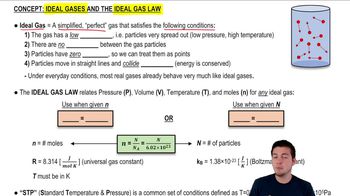
Ideal Gas Law

The Ideal Gas Law relates the pressure, volume, temperature, and number of moles of a gas through the equation PV = nRT. This law is fundamental in understanding the behavior of gases under various conditions and can help identify the type of gas based on its properties.
Recommended video:
Guided course
07:21
Ideal Gases and the Ideal Gas Law

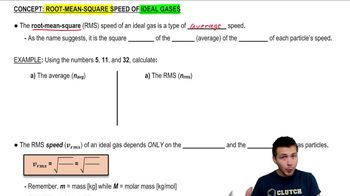
Root Mean Square Speed (rms speed)

The root mean square speed is a measure of the average speed of particles in a gas and is given by the formula v_rms = √(3kT/m), where k is the Boltzmann constant, T is the temperature, and m is the mass of a gas particle. This concept is crucial for determining the molecular mass of the gas when combined with other properties.
Recommended video:
Guided course
05:21
Root-Mean-Square Speed of Ideal Gases

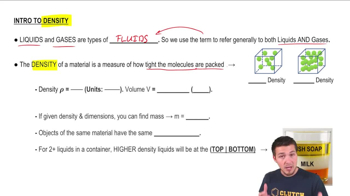
Number Density

Number density refers to the number of particles per unit volume, typically expressed in particles per cubic meter (m⁻³). It is an important parameter in gas physics, as it helps relate the macroscopic properties of the gas, such as pressure and temperature, to the microscopic behavior of its particles.
Recommended video:
Guided course
8:13
Intro to Density
Related Practice
Textbook Question

At 100℃ the rms speed of nitrogen molecules is 576 m/s. Nitrogen at 100℃ and a pressure of 2.0 atm is held in a container with a 10 cm x 10 cm square wall. Estimate the rate of molecular collisions (collisions/s) on this wall.

Textbook Question

By what factor does the rms speed of a molecule change if the temperature is increased from 10℃ to 1000℃?

2
views
Textbook Question

The molecules in a six-particle gas have velocities:

v1=(20i^30j^) m/sv2=(40i^+70j^) m/sv3=(80i^+20j^) m/sv4=30i^ m/sv5=(40i^40j^) m/sv6=(50i^20j^) m/s\(\begin{aligned}\[\vec{v}\)_1 &= (20\(\hat{i}\) - 30\(\hat{j}\)) \(\text{ m/s}\) \(\vec{v}\)_2 &= (40\(\hat{i}\) + 70\(\hat{j}\)) \(\text{ m/s}\) \(\vec{v}\)_3 &= (-80\(\hat{i}\) + 20\(\hat{j}\)) \(\text{ m/s}\) \(\vec{v}\)_4 &= 30\(\hat{i}\) \(\text{ m/s}\) \(\vec{v}\)_5 &= (40\(\hat{i}\) - 40\(\hat{j}\)) \(\text{ m/s}\) \(\vec{v}\)_6 &= (-50\(\hat{i}\) - 20\(\hat{j}\)) \(\text{ m/s}\]\end{aligned}\)

Calculate (a) vavg\(\vec{v}\)_{\(\text{avg}\)}, (b) vavgv_{\(\text{avg}\)}, and (c) vrmsv_{\(\text{rms}\)}.

2
views
Textbook Question

1.0 mol of argon has 3100 J of thermal energy. What is the gas temperature in °C?

2
views
Textbook Question

Eleven molecules have speeds 15, 16, 17, …, 25 m/s. Calculate (a) vavg and (b) vrms.

1
views
Textbook Question

The rms speed of molecules in a gas is 600 m/s. What will be the rms speed if the gas pressure and volume are both halved?