A cylinder of nitrogen and a cylinder of neon are at the same temperature and pressure. The mean free path of a nitrogen molecule is 150 nm. What is the mean free path of a neon atom?

Ch 20: The Micro/Macro Connection
Knight Calc5th EditionPhysics for Scientists and EngineersISBN: 9780137344796Not the one you use?Change textbook
Chapter 20, Problem 11
At 100℃ the rms speed of nitrogen molecules is 576 m/s. Nitrogen at 100℃ and a pressure of 2.0 atm is held in a container with a 10 cm x 10 cm square wall. Estimate the rate of molecular collisions (collisions/s) on this wall.
Verified step by step guidance1
Step 1: Understand the problem. The rate of molecular collisions on the wall can be estimated using the kinetic theory of gases. The key formula to use is: \( R = \frac{1}{2} n v_{\text{rms}} A \), where \( R \) is the rate of collisions, \( n \) is the number density of molecules, \( v_{\text{rms}} \) is the root-mean-square speed, and \( A \) is the area of the wall.
Step 2: Calculate the number density \( n \). Use the ideal gas law \( PV = Nk_B T \), where \( P \) is the pressure, \( V \) is the volume, \( N \) is the number of molecules, \( k_B \) is Boltzmann's constant, and \( T \) is the temperature in kelvins. Rearrange to find \( n = \frac{N}{V} = \frac{P}{k_B T} \). Convert the given pressure (2.0 atm) to pascals and the temperature (100℃) to kelvins.
Step 3: Determine the area \( A \) of the wall. The wall is a square with side length 10 cm. Convert this to meters and calculate the area using \( A = \text{side}^2 \).
Step 4: Substitute the values of \( n \), \( v_{\text{rms}} \), and \( A \) into the formula \( R = \frac{1}{2} n v_{\text{rms}} A \). Ensure all units are consistent (e.g., meters, seconds, pascals).
Step 5: Simplify the expression to find the rate of molecular collisions \( R \). This will give the number of collisions per second on the wall.

Verified video answer for a similar problem:
This video solution was recommended by our tutors as helpful for the problem above.
Video duration:
8mWas this helpful?
Key Concepts
Here are the essential concepts you must grasp in order to answer the question correctly.
Root Mean Square Speed (rms speed)
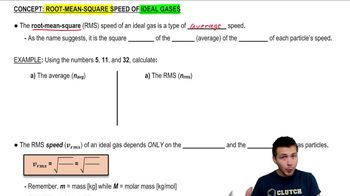
The root mean square speed is a measure of the average speed of particles in a gas. It is calculated from the kinetic theory of gases and is given by the formula v_rms = sqrt(3kT/m), where k is the Boltzmann constant, T is the temperature in Kelvin, and m is the mass of a gas molecule. This concept is crucial for understanding the motion of gas molecules and their kinetic energy.
Recommended video:
Guided course
Root-Mean-Square Speed of Ideal Gases
Kinetic Theory of Gases
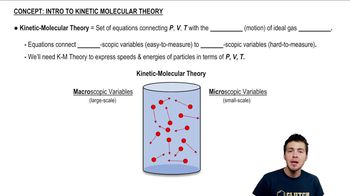
The kinetic theory of gases describes the behavior of gases in terms of particles in constant motion. It explains how temperature, pressure, and volume relate to the motion and collisions of gas molecules. This theory provides the foundation for calculating properties like pressure and collision rates based on molecular speeds and densities.
Recommended video:
Guided course
Introduction to Kinetic-Molecular Theory
Collision Rate
The collision rate refers to the number of collisions that occur between gas molecules and a surface per unit time. It can be estimated using the formula Z = (1/4) * n * A * v_rms, where n is the number density of molecules, A is the area of the wall, and v_rms is the root mean square speed. Understanding this concept is essential for calculating how often gas molecules strike the walls of a container.
Recommended video:
Guided course
Collisions with Springs
Related Practice
Textbook Question
Textbook Question
By what factor does the rms speed of a molecule change if the temperature is increased from 10℃ to 1000℃?
2
views
Textbook Question
The molecules in a six-particle gas have velocities:
Calculate (a) , (b) , and (c) .
2
views
Textbook Question
A cylinder contains gas at a pressure of 2.0 atm and a number density of 4.2 x 1025 m-3. The rms speed of the atoms is 660 m/s. Identify the gas.
1
views
Textbook Question
Eleven molecules have speeds 15, 16, 17, …, 25 m/s. Calculate (a) vavg and (b) vrms.
1
views
Textbook Question
The rms speed of molecules in a gas is 600 m/s. What will be the rms speed if the gas pressure and volume are both halved?