Ch 20: The Micro/Macro Connection
Knight Calc - Physics for Scientists and Engineers 5th Edition
Knight Calc5th EditionPhysics for Scientists and EngineersISBN: 9780137344796Not the one you use?Change textbook
Chapter 20, Problem 3

A 1.0 m ✕ 1.0 m ✕ 1.0 m cube of nitrogen gas is at 20℃ and 1.0 atm. Estimate the number of molecules in the cube with a speed between 700 m/s and 1000 m/s.

Verified step by step guidance
1
Step 1: Begin by understanding the problem. We are tasked with estimating the number of nitrogen gas molecules in a cube with a speed between 700 m/s and 1000 m/s. This involves using the Maxwell-Boltzmann distribution to determine the fraction of molecules within the specified speed range.
Step 2: Calculate the total number of molecules in the cube. Use the ideal gas law, \( PV = nRT \), where \( P \) is pressure (1.0 atm), \( V \) is volume (1.0 m³), \( n \) is the number of moles, \( R \) is the gas constant (8.314 J/(mol·K)), and \( T \) is temperature in Kelvin (convert 20℃ to 293 K). Rearrange the equation to solve for \( n \): \( n = \frac{PV}{RT} \). Then, multiply \( n \) by Avogadro's number (\( 6.022 \times 10^{23} \)) to find the total number of molecules.
Step 3: Use the Maxwell-Boltzmann speed distribution formula to find the fraction of molecules with speeds between 700 m/s and 1000 m/s. The probability density function is given by \( f(v) = 4 \pi \left( \frac{m}{2 \pi k_B T} \right)^{3/2} v^2 e^{-\frac{mv^2}{2k_B T}} \), where \( m \) is the mass of a nitrogen molecule, \( k_B \) is Boltzmann's constant (\( 1.38 \times 10^{-23} \) J/K), \( T \) is temperature, and \( v \) is speed. Integrate this function over the range \( v = 700 \) m/s to \( v = 1000 \) m/s to find the fraction of molecules in this speed range.
Step 4: Determine the mass of a nitrogen molecule. Nitrogen gas (N₂) has a molar mass of approximately 28 g/mol. Convert this to kilograms per molecule by dividing by Avogadro's number: \( m = \frac{28 \times 10^{-3}}{6.022 \times 10^{23}} \) kg.
Step 5: Multiply the fraction of molecules (from Step 3) by the total number of molecules (from Step 2) to estimate the number of molecules in the cube with speeds between 700 m/s and 1000 m/s.

Verified video answer for a similar problem:

This video solution was recommended by our tutors as helpful for the problem above.
Video duration:
5m
Was this helpful?

Key Concepts

Here are the essential concepts you must grasp in order to answer the question correctly.

Ideal Gas Law

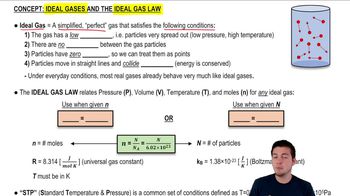
The Ideal Gas Law relates the pressure, volume, temperature, and number of moles of a gas through the equation PV = nRT. This law is fundamental in understanding the behavior of gases under various conditions and allows us to calculate the number of moles of nitrogen gas in the cube, which is essential for estimating the number of molecules.
Recommended video:
Guided course
07:21
Ideal Gases and the Ideal Gas Law

Kinetic Molecular Theory

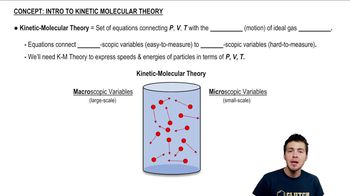
Kinetic Molecular Theory explains the behavior of gas molecules in terms of their motion. It posits that gas molecules are in constant random motion and that the temperature of a gas is directly related to the average kinetic energy of its molecules. This theory helps in understanding the distribution of molecular speeds and is crucial for estimating how many molecules fall within a specific speed range.
Recommended video:
Guided course
01:50
Introduction to Kinetic-Molecular Theory

Maxwell-Boltzmann Distribution

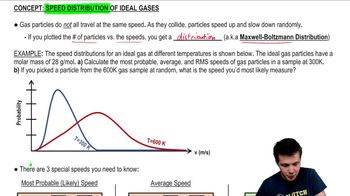
The Maxwell-Boltzmann Distribution describes the distribution of speeds among molecules in a gas. It provides a statistical framework to determine the fraction of molecules that have speeds within a certain range at a given temperature. This concept is vital for calculating the number of nitrogen molecules in the specified speed range of 700 m/s to 1000 m/s.
Recommended video:
Guided course
07:59
Speed Distribution & Special Speeds of Ideal Gases