Ch 20: The Micro/Macro Connection
Knight Calc - Physics for Scientists and Engineers 5th Edition
Knight Calc5th EditionPhysics for Scientists and EngineersISBN: 9780137344796Not the one you use?Change textbook
Chapter 20, Problem 59

A gas of 1.0 x 10²⁰ atoms or molecules has 1.0 J of thermal energy. Its molar specific heat at constant pressure is 20.8 J/ mol K. What is the temperature of the gas?

Verified step by step guidance
1
Step 1: Start by identifying the given values in the problem. The number of atoms or molecules is \( N = 1.0 \times 10^{20} \), the thermal energy is \( Q = 1.0 \ \text{J} \), and the molar specific heat at constant pressure is \( C_p = 20.8 \ \text{J/mol·K} \).
Step 2: Recall the relationship between the number of moles \( n \) and the number of particles \( N \). Use the formula \( n = \frac{N}{N_A} \), where \( N_A \) is Avogadro's number \( 6.022 \times 10^{23} \ \text{particles/mol} \).
Step 3: Substitute the given value of \( N \) into the formula for \( n \) to calculate the number of moles of the gas. This will give you \( n \), the amount of substance in moles.
Step 4: Use the formula for thermal energy at constant pressure, \( Q = n C_p \Delta T \), where \( \Delta T \) is the change in temperature. Rearrange this equation to solve for \( \Delta T \): \( \Delta T = \frac{Q}{n C_p} \).
Step 5: Substitute the values of \( Q \), \( n \), and \( C_p \) into the equation for \( \Delta T \) to calculate the temperature change. This will give you the temperature of the gas in Kelvin.

Verified video answer for a similar problem:

This video solution was recommended by our tutors as helpful for the problem above.
Video duration:
5m
Was this helpful?

Key Concepts

Here are the essential concepts you must grasp in order to answer the question correctly.

Thermal Energy

Thermal energy refers to the total kinetic energy of the particles in a substance due to their motion. In the context of gases, this energy is related to the temperature and the number of particles present. The relationship between thermal energy, temperature, and the number of particles is crucial for understanding how energy is distributed among the gas molecules.
Recommended video:
Guided course
05:21
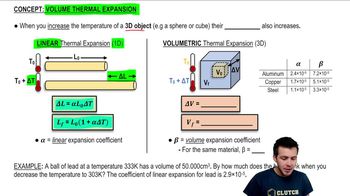
Volume Thermal Expansion

Molar Specific Heat

Molar specific heat at constant pressure is the amount of heat required to raise the temperature of one mole of a substance by one degree Kelvin while maintaining constant pressure. It is a critical property that helps relate the thermal energy of a gas to its temperature change. In this problem, the specific heat value allows us to calculate the temperature change based on the given thermal energy.
Recommended video:
Guided course
06:50
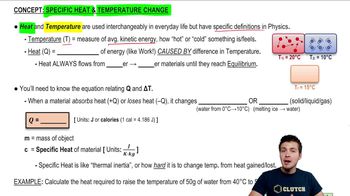
Specific Heat & Temperature Changes

Ideal Gas Law

The Ideal Gas Law is a fundamental equation in thermodynamics that relates the pressure, volume, temperature, and number of moles of an ideal gas. Although not directly used in this question, understanding this law provides context for how temperature and energy are interrelated in gases. It helps in comprehending the behavior of gases under various conditions, which is essential for solving thermal energy problems.
Recommended video:
Guided course
07:21
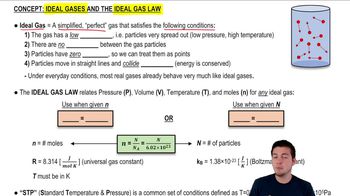
Ideal Gases and the Ideal Gas Law