Ch 20: The Micro/Macro Connection
Knight Calc - Physics for Scientists and Engineers 5th Edition
Knight Calc5th EditionPhysics for Scientists and EngineersISBN: 9780137344796Not the one you use?Change textbook
Chapter 20, Problem 58c

A 100 cm³ box contains helium at a pressure of 2.0 atm and a temperature of 100℃. It is placed in thermal contact with a 200 cm³ box containing argon at a pressure of 4.0 atm and a temperature of 400℃. How much heat energy is transferred, and in which direction?

Verified step by step guidance
1
Step 1: Begin by identifying the key variables for each gas. For helium, the initial pressure (P₁) is 2.0 atm, the initial temperature (T₁) is 100℃ (convert to Kelvin: T₁ = 100 + 273 = 373 K), and the volume (V₁) is 100 cm³. For argon, the initial pressure (P₂) is 4.0 atm, the initial temperature (T₂) is 400℃ (convert to Kelvin: T₂ = 400 + 273 = 673 K), and the volume (V₂) is 200 cm³.
Step 2: Use the ideal gas law, \( PV = nRT \), to calculate the number of moles (n) for each gas. For helium: \( n₁ = \frac{P₁ V₁}{RT₁} \), where R is the universal gas constant (8.314 J/(mol·K)). For argon: \( n₂ = \frac{P₂ V₂}{RT₂} \). Substitute the given values to find \( n₁ \) and \( n₂ \).
Step 3: Determine the final equilibrium temperature (Tₓ) after thermal contact. Since heat transfer occurs until thermal equilibrium is reached, use the principle of conservation of energy: \( Q_{helium} + Q_{argon} = 0 \). The heat transferred for each gas is given by \( Q = nC_v \Delta T \), where \( C_v \) is the molar specific heat at constant volume. For monatomic gases like helium and argon, \( C_v = \frac{3}{2}R \). Set up the equation \( n₁C_v(Tₓ - T₁) + n₂C_v(Tₓ - T₂) = 0 \) and solve for \( Tₓ \).
Step 4: Calculate the heat energy transferred for each gas using \( Q = nC_v \Delta T \). For helium: \( Q_{helium} = n₁C_v(Tₓ - T₁) \). For argon: \( Q_{argon} = n₂C_v(Tₓ - T₂) \). Substitute the values of \( n₁ \), \( n₂ \), \( C_v \), and \( Tₓ \) to find the magnitude of heat transferred for each gas.
Step 5: Determine the direction of heat transfer. If \( Q_{helium} > 0 \), heat is absorbed by helium, and if \( Q_{helium} < 0 \), heat is released by helium. Similarly, analyze \( Q_{argon} \). The direction of heat transfer will be from the hotter gas (argon) to the cooler gas (helium) until equilibrium is reached.

Verified video answer for a similar problem:

This video solution was recommended by our tutors as helpful for the problem above.
Video duration:
13m
Was this helpful?

Key Concepts

Here are the essential concepts you must grasp in order to answer the question correctly.

Thermal Energy Transfer

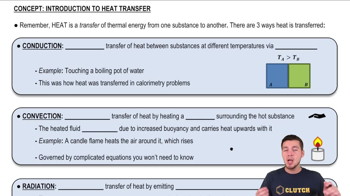
Thermal energy transfer refers to the movement of heat from one body or system to another due to a temperature difference. Heat flows from the hotter object to the cooler one until thermal equilibrium is reached. In this scenario, the heat will transfer from the argon gas at 400℃ to the helium gas at 100℃, as the argon is at a higher temperature.
Recommended video:
Guided course
05:14
Overview of Heat Transfer

Ideal Gas Law

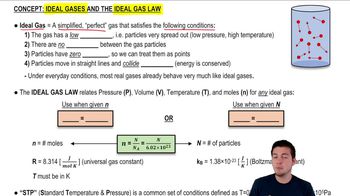
The Ideal Gas Law, expressed as PV = nRT, relates the pressure (P), volume (V), and temperature (T) of an ideal gas to the number of moles (n) and the universal gas constant (R). This law is essential for calculating the properties of gases in the boxes, allowing us to determine how changes in temperature and pressure affect the gases' behavior and energy content.
Recommended video:
Guided course
07:21
Ideal Gases and the Ideal Gas Law

Specific Heat Capacity

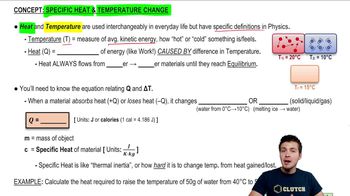
Specific heat capacity is the amount of heat required to raise the temperature of a unit mass of a substance by one degree Celsius. It is crucial for calculating the heat energy transferred between the helium and argon gases. Knowing the specific heat capacities of both gases allows us to quantify the heat transfer during the thermal interaction between the two boxes.
Recommended video:
Guided course
06:50
Specific Heat & Temperature Changes