
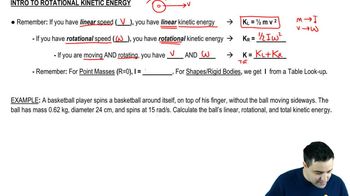
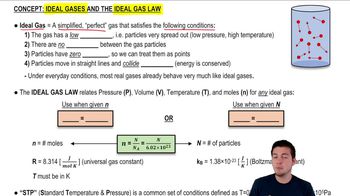
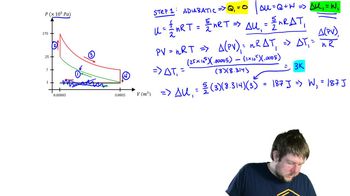
A water molecule has its three atoms arranged in a 'V' shape, so it has rotational kinetic energy around any of three mutually perpendicular axes. However, like diatomic molecules, its vibrational modes are not active at temperatures below 1000 K. What is the thermal energy of 2.0 mol of steam at a temperature of 160°C?
What is the total rotational kinetic energy of 1.0 mol of nitrogen gas at 300 K?
Verified step by step guidance
Verified video answer for a similar problem:
Key Concepts
Rotational Kinetic Energy
Ideal Gas Law
Degrees of Freedom
A gas of 1.0 x 10²⁰ atoms or molecules has 1.0 J of thermal energy. Its molar specific heat at constant pressure is 20.8 J/ mol K. What is the temperature of the gas?
A nitrogen molecule consists of two nitrogen atoms separated by 0.11 nm, the bond length. Treat the molecule as a rotating dumbbell and find the rms angular velocity at this temperature of a nitrogen molecule around the z-axis, as shown in Figure 20.10.
A monatomic gas is adiabatically compressed to 1/8 of its initial volume. Does each of the following quantities change? If so, does it increase or decrease, and by what factor? If not, why not? The mean free path.
2.0 g of helium at an initial temperature of 300 K interacts thermally with 8.0 g of oxygen at an initial temperature of 600 K. How much heat energy is transferred, and in which direction?
A 100 cm³ box contains helium at a pressure of 2.0 atm and a temperature of 100℃. It is placed in thermal contact with a 200 cm³ box containing argon at a pressure of 4.0 atm and a temperature of 400℃. How much heat energy is transferred, and in which direction?
