
On earth, STP is based on the average atmospheric pressure at the surface and on a phase change of water that occurs at an easily produced temperature, being only slightly cooler than the average air temperature. The atmosphere of Venus is almost entirely carbon dioxide (CO2), the pressure at the surface is a staggering 93 atm, and the average temperature is 470℃. Venusian scientists, if they existed, would certainly use the surface pressure as part of their definition of STP. To complete the definition, they would seek a phase change that occurs near the average temperature. Conveniently, the melting point of the element tellurium is 450℃. What are (a) the rms speed and (b) the mean free path of carbon dioxide molecules at Venusian STP based on this phase change in tellurium? The radius of a CO2 molecule is 1.5 x 10⁻¹⁰ m.

- Ch 01: Concepts of Motion35
- Ch 02: Kinematics in One Dimension75
- Ch 03: Vectors and Coordinate Systems58
- Ch 04: Kinematics in Two Dimensions60
- Ch 05: Force and Motion23
- Ch 06: Dynamics I: Motion Along a Line53
- Ch 07: Newton's Third Law27
- Ch 08: Dynamics II: Motion in a Plane52
- Ch 09: Work and Kinetic Energy56
- Ch 10: Interactions and Potential Energy50
- Ch 11: Impulse and Momentum56
- Ch 12: Rotation of a Rigid Body71
- Ch 13: Newton's Theory of Gravity52
- Ch 14: Fluids and Elasticity44
- Ch 15: Oscillations55
- Ch 16: Traveling Waves37
- Ch 17: Superposition39
- Ch 18: A Macroscopic Description of Matter53
- Ch 19: Work, Heat, and the First Law of Thermodynamics60
- Ch 20: The Micro/Macro Connection53
- Ch 21: Heat Engines and Refrigerators34
- Ch 22: Electric Charges and Forces40
- Ch 23: The Electric Field39
- Ch 24: Gauss' Law32
- Ch 25: The Electric Potential63
- Ch 26: Potential and Field57
- Ch 27: Current and Resistance42
- Ch 28: Fundamentals of Circuits39
- Ch 29: The Magnetic Field47
- Ch 30: Electromagnetic Induction60
- Ch 31: Electromagnetic Fields and Waves32
- Ch 32: AC Circuits63
- Ch 33: Wave Optics32
- Ch 34: Ray Optics57
- Ch 35: Optical Instruments30
- Ch 36: Special Relativity38
- Ch 37: The Foundations of Modern Physics25
- Ch 38: Quantization49
- Ch 39: Wave Functions and Uncertainty31
- Ch 40: One-Dimensional Quantum Mechanics35
- Ch 41: Atomic Physics18
- Ch 42: Nuclear Physics27
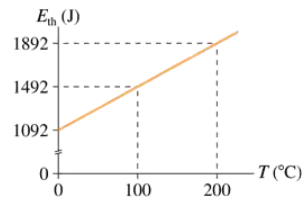
FIGURE P20.57 shows the thermal energy of 0.14 mol of gas as a function of temperature. What is Cᵥ for this gas?
 Verified step by step guidance
Verified video answer for a similar problem:
Key Concepts
Thermal Energy
 05:21
05:21
Heat Capacity (Cᵥ)
 05:14
05:14Moles of Gas
 07:19
07:195.0 x 10²³ nitrogen molecules collide with a 10 cm2 wall each second. Assume that the molecules all travel with a speed of 400 m/s and strike the wall head-on. What is the pressure on the wall?
Uranium has two naturally occurring isotopes. has a natural abundance of and has an abundance of . It is the rarer that is needed for nuclear reactors. The isotopes are separated by forming uranium hexafluoride, , which is a gas, then allowing it to diffuse through a series of porous membranes. has a slightly larger rms speed than and diffuses slightly faster. Many repetitions of this procedure gradually separate the two isotopes. What is the ratio of the rms speed of to that of ?
A gas of 1.0 x 10²⁰ atoms or molecules has 1.0 J of thermal energy. Its molar specific heat at constant pressure is 20.8 J/ mol K. What is the temperature of the gas?
A 100 cm³ box contains helium at a pressure of 2.0 atm and a temperature of 100℃. It is placed in thermal contact with a 200 cm³ box containing argon at a pressure of 4.0 atm and a temperature of 400℃. What is the final thermal energy of each gas?
A 100 cm³ box contains helium at a pressure of 2.0 atm and a temperature of 100℃. It is placed in thermal contact with a 200 cm³ box containing argon at a pressure of 4.0 atm and a temperature of 400℃. How much heat energy is transferred, and in which direction?