A 2.0 kg object is moving to the right with a speed of when it experiences the force shown in FIGURE EX11.9. What are the object's speed and direction after the force ends?

Ch 11: Impulse and Momentum
Knight Calc5th EditionPhysics for Scientists and EngineersISBN: 9780137344796Not the one you use?Change textbook
Chapter 11, Problem 5
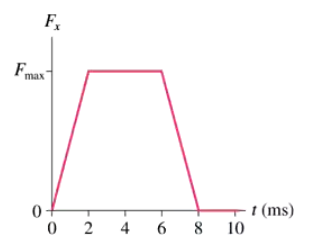
In FIGURE EX11.5, what value of Fmax gives an impulse of 6.0 N s?

Verified step by step guidance1
Step 1: Recall the formula for impulse, which is given by \( J = F \cdot \Delta t \), where \( J \) is the impulse, \( F \) is the force, and \( \Delta t \) is the time interval during which the force acts.
Step 2: From the graph, observe that the force \( F_{\text{max}} \) acts over a time interval \( \Delta t \) from \( t = 4 \, \text{s} \) to \( t = 10 \, \text{s} \). Calculate \( \Delta t \) as \( \Delta t = 10 - 4 = 6 \, \text{s} \).
Step 3: Substitute the given impulse \( J = 6.0 \, \text{N} \cdot \text{s} \) and the time interval \( \Delta t = 6 \, \text{s} \) into the formula \( J = F \cdot \Delta t \). Rearrange the formula to solve for \( F \): \( F = \frac{J}{\Delta t} \).
Step 4: Perform the substitution: \( F = \frac{6.0}{6} \). This will give the value of \( F_{\text{max}} \).
Step 5: Interpret the result: The calculated \( F_{\text{max}} \) represents the maximum constant force that acts over the time interval \( \Delta t \) to produce the given impulse.

Verified video answer for a similar problem:
This video solution was recommended by our tutors as helpful for the problem above.
Video duration:
5mWas this helpful?
Key Concepts
Here are the essential concepts you must grasp in order to answer the question correctly.
Impulse
Impulse is defined as the change in momentum of an object when a force is applied over a period of time. It is mathematically represented as the product of force and the time duration for which the force acts. In this context, the impulse is given as 6.0 N·s, indicating the total effect of the force applied over the specified time interval.
Recommended video:
Guided course
Impulse & Impulse-Momentum Theorem
Force-Time Graph
A force-time graph visually represents how force varies with time. The area under the curve of this graph corresponds to the impulse experienced by an object. In the provided graph, the force is constant at Fmax for a certain duration, allowing for straightforward calculation of impulse by multiplying Fmax by the time interval during which the force is applied.
Recommended video:
Guided course
Velocity-Time Graphs & Acceleration
Calculating Fmax
To find the maximum force (Fmax) that results in a specific impulse, one can use the relationship between impulse, force, and time. Given the impulse (6.0 N·s) and the duration of the force application (which can be inferred from the graph), Fmax can be calculated using the formula: Impulse = Fmax × time. This allows for determining the required force to achieve the desired impulse.
Recommended video:
Guided course
Calculating Dot Product Using Vector Components
Related Practice
Textbook Question
Textbook Question
FIGURE EX11.6 is an incomplete momentum bar chart for a collision that lasts 10 ms. What are the magnitude and direction of the average collision force exerted on the object?
2
views
Textbook Question
What are the velocities of a 75 kg skydiver falling with ?
2
views
Textbook Question
What is the impulse on a 3.0 kg particle that experiences the force shown in FIGURE EX11.4?
6
views
Textbook Question
What impulse does the force shown in FIGURE EX11.3 exert on a 250 g particle?
1
views
Textbook Question
A 2.0 kg object is moving to the right with a speed of 1.0 m/s when it experiences the force shown in FIGURE EX11.8. What are the object's speed and direction after the force ends?
1
views