
Textbook Question
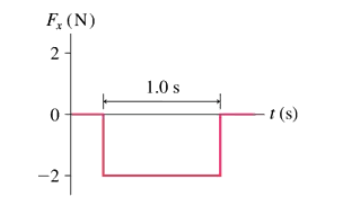
A 2.0 kg object is moving to the right with a speed of when it experiences the force shown in FIGURE EX11.9. What are the object's speed and direction after the force ends?

 Verified step by step guidance
 06:54
06:54
 05:17
05:17 08:25
08:25A 2.0 kg object is moving to the right with a speed of when it experiences the force shown in FIGURE EX11.9. What are the object's speed and direction after the force ends?
FIGURE EX11.6 is an incomplete momentum bar chart for a collision that lasts 10 ms. What are the magnitude and direction of the average collision force exerted on the object?
A force in the +x-direction increases linearly from 0 N to 9000 N in 5.0 s, then suddenly ends. What impulse does this force provide?
What is the impulse on a 3.0 kg particle that experiences the force shown in FIGURE EX11.4?
Far in space, where gravity is negligible, a 425 kg rocket traveling at 75 m/s in the +x-direction fires its engines. FIGURE EX11.10 shows the thrust force as a function of time. The mass lost by the rocket during these 30 s is negligible. At what time does the rocket reach its maximum speed? What is the maximum speed?
In FIGURE EX11.5, what value of Fmax gives an impulse of 6.0 N s?