Ch 11: Impulse and Momentum
Knight Calc - Physics for Scientists and Engineers 5th Edition
Knight Calc5th EditionPhysics for Scientists and EngineersISBN: 9780137344796Not the one you use?Change textbook
Chapter 11, Problem 9

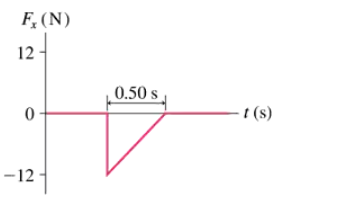
A 2.0 kg object is moving to the right with a speed of when it experiences the force shown in FIGURE EX11.9. What are the object's speed and direction after the force ends?

Verified step by step guidance
1
Step 1: Analyze the graph provided. The graph shows the force Fx (in Newtons) acting on the object as a function of time t (in seconds). The force is positive for 0.30 seconds, then negative for 0.22 seconds, and returns to zero. The area under the curve represents the impulse delivered to the object.
Step 2: Calculate the impulse delivered during the positive force phase. Impulse is given by the area under the curve, which is a rectangle. Use the formula: I = F × t, where F is the force and t is the time duration.
Step 3: Calculate the impulse delivered during the negative force phase. This is also the area under the curve, but since the force is negative, the impulse will be negative. Use the same formula: I = F × t.
Step 4: Determine the net impulse by summing the impulses from the positive and negative force phases. Net impulse = Impulse (positive) + Impulse (negative).
Step 5: Use the impulse-momentum theorem to find the final velocity. The theorem states: I = Δp = m × Δv, where m is the mass of the object and Δv is the change in velocity. Solve for the final velocity by adding the change in velocity to the initial velocity, considering the direction of the net impulse.

Verified video answer for a similar problem:

This video solution was recommended by our tutors as helpful for the problem above.
Video duration:
4m
Was this helpful?

Key Concepts

Here are the essential concepts you must grasp in order to answer the question correctly.

Newton's Second Law of Motion

Newton's Second Law states that the acceleration of an object is directly proportional to the net force acting on it and inversely proportional to its mass. This relationship is expressed by the equation F = ma, where F is the net force, m is the mass, and a is the acceleration. Understanding this law is crucial for analyzing how the force applied to the object affects its motion.
Recommended video:
Guided course
06:54
Intro to Forces & Newton's Second Law

Impulse and Momentum

Impulse is defined as the change in momentum of an object when a force is applied over a period of time. It is calculated as the product of the average force and the time duration during which the force acts. The impulse-momentum theorem states that the impulse on an object is equal to the change in its momentum, which is essential for determining the object's final speed and direction after the force has ended.
Recommended video:
Guided course
06:00
Impulse & Impulse-Momentum Theorem

Graphical Analysis of Force vs. Time

The force vs. time graph provides a visual representation of how force varies over time. The area under the curve of this graph represents the impulse experienced by the object. By calculating the area, one can determine the total impulse applied, which is necessary for finding the change in momentum and ultimately the final speed and direction of the object after the force ceases.
Recommended video:
Guided course
05:00
Dimensional Analysis