Ch 11: Impulse and Momentum
Knight Calc - Physics for Scientists and Engineers 5th Edition
Knight Calc5th EditionPhysics for Scientists and EngineersISBN: 9780137344796Not the one you use?Change textbook
Chapter 11, Problem 2b

What are the velocities of a 75 kg skydiver falling with p=4100j kg m/s\(\overrightarrow{p}\)=-4100\(\mathbf{j}\]\text{ kg m/s}\)?

Verified step by step guidance
1
Step 1: Recall the relationship between momentum and velocity. Momentum \( \mathbf{p} \) is given by the formula \( \mathbf{p} = m \cdot \mathbf{v} \), where \( m \) is the mass of the object and \( \mathbf{v} \) is its velocity vector.
Step 2: Rearrange the formula to solve for velocity \( \mathbf{v} \). This gives \( \mathbf{v} = \frac{\mathbf{p}}{m} \).
Step 3: Substitute the given values into the formula. The momentum \( \mathbf{p} \) is \( -4100 \mathbf{j} \; \text{kg·m/s} \), and the mass \( m \) is \( 75 \; \text{kg} \).
Step 4: Perform the division for each component of the momentum vector. Since the momentum is only in the \( \mathbf{j} \)-direction, the velocity will also only have a \( \mathbf{j} \)-component. Compute \( \mathbf{v}_j = \frac{-4100}{75} \; \text{m/s} \).
Step 5: Express the velocity vector \( \mathbf{v} \) in terms of its components. The result will be \( \mathbf{v} = 0 \mathbf{i} + (\text{calculated value}) \mathbf{j} + 0 \mathbf{k} \; \text{m/s} \).

Verified video answer for a similar problem:

This video solution was recommended by our tutors as helpful for the problem above.
Video duration:
2m
Was this helpful?

Key Concepts

Here are the essential concepts you must grasp in order to answer the question correctly.

Momentum

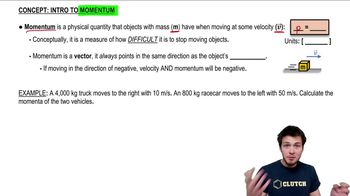
Momentum is a vector quantity defined as the product of an object's mass and its velocity. It is expressed in units of kg m/s and is crucial in understanding the motion of objects, especially in collisions or when forces are applied. In the context of the skydiver, the given momentum value indicates the direction and magnitude of their motion.
Recommended video:
Guided course
05:17
Intro to Momentum

Velocity

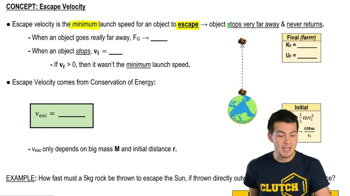
Velocity is a vector quantity that describes the rate of change of an object's position with respect to time. It includes both speed and direction, making it essential for analyzing motion. In this case, the skydiver's velocity can be derived from their momentum by dividing the momentum by their mass, providing insight into how fast and in which direction they are falling.
Recommended video:
Guided course
7:27
Escape Velocity

Free Fall

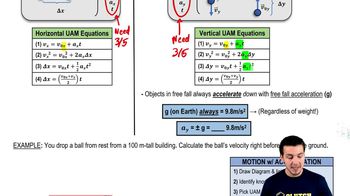
Free fall refers to the motion of an object under the influence of gravity alone, with no other forces acting on it, such as air resistance. For a skydiver, this concept is important as it describes their acceleration towards the Earth due to gravity, which is approximately 9.81 m/s². Understanding free fall helps in calculating the skydiver's velocity and the effects of air resistance on their descent.
Recommended video:
Guided course
08:36
Vertical Motion & Free Fall