Ch 11: Impulse and Momentum
Knight Calc - Physics for Scientists and Engineers 5th Edition
Knight Calc5th EditionPhysics for Scientists and EngineersISBN: 9780137344796Not the one you use?Change textbook
Chapter 11, Problem 1

At what speed do a bicycle and its rider, with a combined mass of 100 kg, have the same momentum as a 1500 kg car traveling at 5.0 m/s?

Verified step by step guidance
1
Step 1: Recall the formula for momentum, which is given by \( p = m \cdot v \), where \( p \) is momentum, \( m \) is mass, and \( v \) is velocity.
Step 2: Calculate the momentum of the car. Using the car's mass \( m_{\text{car}} = 1500 \; \text{kg} \) and velocity \( v_{\text{car}} = 5.0 \; \text{m/s} \), substitute these values into the formula: \( p_{\text{car}} = m_{\text{car}} \cdot v_{\text{car}} \).
Step 3: Set the momentum of the bicycle and rider equal to the momentum of the car, since the problem states they have the same momentum. Let \( m_{\text{bike}} = 100 \; \text{kg} \) and \( v_{\text{bike}} \) be the unknown velocity of the bicycle and rider. The equation becomes \( m_{\text{bike}} \cdot v_{\text{bike}} = p_{\text{car}} \).
Step 4: Solve for \( v_{\text{bike}} \) by isolating it in the equation: \( v_{\text{bike}} = \frac{p_{\text{car}}}{m_{\text{bike}}} \). Substitute \( p_{\text{car}} \) from Step 2 and \( m_{\text{bike}} = 100 \; \text{kg} \) into this equation.
Step 5: Simplify the expression to find \( v_{\text{bike}} \). This will give the velocity at which the bicycle and rider have the same momentum as the car.

Verified video answer for a similar problem:

This video solution was recommended by our tutors as helpful for the problem above.
Video duration:
3m
Was this helpful?

Key Concepts

Here are the essential concepts you must grasp in order to answer the question correctly.

Momentum

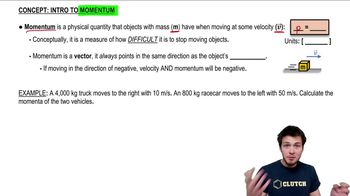
Momentum is a vector quantity defined as the product of an object's mass and its velocity. It is expressed mathematically as p = mv, where p is momentum, m is mass, and v is velocity. Momentum is conserved in isolated systems, meaning that the total momentum before an event equals the total momentum after, making it a crucial concept in analyzing collisions and motion.
Recommended video:
Guided course
05:17
Intro to Momentum

Mass

Mass is a measure of the amount of matter in an object, typically measured in kilograms. It is a scalar quantity and does not change regardless of the object's location in the universe. In the context of momentum, mass directly influences the momentum of an object; a greater mass results in greater momentum if the velocity remains constant.
Recommended video:
Guided course
20:32
Mass Spectrometers

Velocity

Velocity is a vector quantity that describes the rate of change of an object's position with respect to time, incorporating both speed and direction. It is crucial for calculating momentum, as momentum depends on both the mass of an object and its velocity. Understanding velocity allows us to determine how fast an object is moving and in which direction, which is essential for solving problems involving motion.
Recommended video:
Guided course
7:27
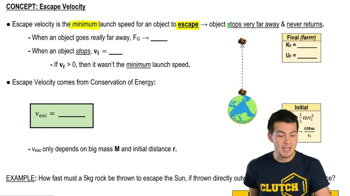
Escape Velocity