
FIGURE P7.47 shows a 200 g hamster sitting on an 800 g wedge-shaped block. The block, in turn, rests on a spring scale. An extra-fine lubricating oil having μs = μk = 0 is sprayed on the top surface of the block, causing the hamster to slide down. Friction between the block and the scale is large enough that the block does not slip on the scale. What does the scale read, in grams, as the hamster slides down?
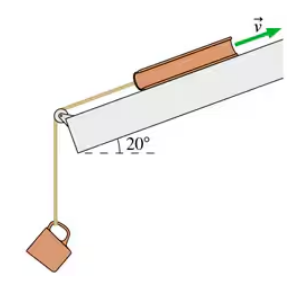
The 1.0 kg physics book in FIGURE P7.40 is connected by a string to a 500 g coffee cup. The book is given a push up the slope and released with a speed of 3.0 m/s. The coefficients of friction are μs = 0.50 and μk = 0.20. At the highest point, does the book stick to the slope, or does it slide back down?

Verified step by step guidance
Verified video answer for a similar problem:
Key Concepts
Friction
Energy Conservation
Newton's Second Law
A 75 kg archer on ice skates is standing at rest on very smooth ice. He shoots a 450 g arrow horizontally. When released, the arrow reaches a speed of 110 m/s in 0.25 s. Assume that the force of the bow string on the arrow is constant. What is the archer's recoil speed?
In FIGURE CP7.54, find an expression for the acceleration of m1. The pulleys are massless and frictionless. Hint: Think carefully about the acceleration constraint.
A house painter uses the chair-and-pulley arrangement of FIGURE P7.45 to lift himself up the side of a house. The painter's mass is 70 kg and the chair's mass is 10 kg. With what force must he pull down on the rope in order to accelerate upward at 0.20 m/s².
Your forehead can withstand a force of about 6.0 kN before fracturing, while your cheekbone can withstand only about 1.3 kN. Suppose a 140 g baseball traveling at 30 m/s strikes your head and stops in 1.5 ms. What is the magnitude of the force that stops the baseball?
A 2.0 kg block on a horizontal, frictionless surface is connected by a massless spring and a massless, frictionless pulley to a hanging mass. For what value of the hanging mass does the block accelerate at 1.5 m/s²?
