
Ch 07: Newton's Third Law
Knight Calc - Physics for Scientists and Engineers 5th Edition
Knight Calc5th EditionPhysics for Scientists and EngineersISBN: 9780137344796Not the one you use?Change textbook
Chapter 7, Problem 54

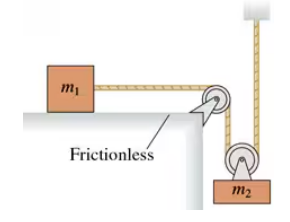
In FIGURE CP7.54, find an expression for the acceleration of m1. The pulleys are massless and frictionless. Hint: Think carefully about the acceleration constraint.

Verified step by step guidance
1
Identify the forces acting on each mass. For m₁, the forces are its weight (m₁g) acting downward and the tension (T) in the string acting upward. For m₂, the forces are its weight (m₂g) acting downward and the tension (T) in the string acting upward. Assume the pulleys are massless and frictionless, so the tension is the same throughout the string.
Establish the acceleration constraint. Since the string is inextensible, the accelerations of m₁ and m₂ are related. If m₁ moves upward with acceleration a₁, m₂ must move downward with acceleration a₂. The relationship between these accelerations depends on the pulley system. For a single movable pulley, the constraint is typically a₁ = 2a₂.
Write Newton's second law for each mass. For m₁: T - m₁g = m₁a₁. For m₂: m₂g - T = m₂a₂. These equations describe the net force on each mass and their respective accelerations.
Substitute the acceleration constraint (a₁ = 2a₂) into the equations. Replace a₁ in the equation for m₁ with 2a₂ to express everything in terms of a single variable (a₂). This step ensures the system of equations is consistent with the physical setup.
Solve the system of equations to find an expression for the acceleration of m₁ (a₁). Combine the two equations by eliminating T, and then solve for a₂. Once a₂ is determined, use the relationship a₁ = 2a₂ to express the acceleration of m₁ in terms of m₁, m₂, and g.

Verified video answer for a similar problem:

This video solution was recommended by our tutors as helpful for the problem above.
Video duration:
12m
Was this helpful?

Key Concepts

Here are the essential concepts you must grasp in order to answer the question correctly.

Newton's Second Law

Newton's Second Law states that the acceleration of an object is directly proportional to the net force acting on it and inversely proportional to its mass. This relationship is expressed mathematically as F = ma, where F is the net force, m is the mass, and a is the acceleration. Understanding this law is crucial for analyzing the forces acting on m₁ and determining its acceleration.
Recommended video:
Guided course
06:54
Intro to Forces & Newton's Second Law

Acceleration Constraint

In systems involving pulleys and multiple masses, the acceleration constraint refers to the relationship between the accelerations of different masses connected by the pulley system. For example, if one mass moves up, another mass connected by the same rope must move down, leading to a specific ratio of their accelerations. Recognizing this constraint is essential for deriving the correct expression for the acceleration of m₁.
Recommended video:
Guided course
05:47
Intro to Acceleration

Massless and Frictionless Pulleys

Massless and frictionless pulleys simplify the analysis of mechanical systems by eliminating additional forces that would otherwise complicate calculations. A massless pulley does not contribute to the overall mass of the system, while a frictionless pulley ensures that there is no energy loss due to friction. This idealization allows for a straightforward application of Newton's laws and the acceleration constraint in solving for the acceleration of m₁.
Recommended video:
Guided course
08:28
Torque on Discs & Pulleys