
Ch 07: Newton's Third Law
Knight Calc - Physics for Scientists and Engineers 5th Edition
Knight Calc5th EditionPhysics for Scientists and EngineersISBN: 9780137344796Not the one you use?Change textbook
Chapter 7, Problem 45

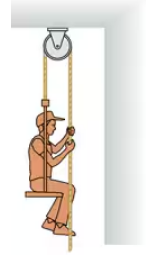
A house painter uses the chair-and-pulley arrangement of FIGURE P7.45 to lift himself up the side of a house. The painter's mass is 70 kg and the chair's mass is 10 kg. With what force must he pull down on the rope in order to accelerate upward at 0.20 m/s².

Verified step by step guidance
1
Step 1: Identify the forces acting on the system. The painter and the chair together form the system, and their combined mass is the sum of the painter's mass (70 kg) and the chair's mass (10 kg), which equals 80 kg. The forces acting on the system include the gravitational force (weight) and the tension in the rope.
Step 2: Calculate the gravitational force acting on the system. The gravitational force can be calculated using the formula: Fg=mg, where m is the total mass (80 kg) and g is the acceleration due to gravity (approximately 9.8 m/s²).
Step 3: Apply Newton's second law to the system. The net force required to accelerate the system upward can be calculated using the formula: Fnet=ma, where a is the upward acceleration (0.20 m/s²).
Step 4: Determine the total tension in the rope. The total tension must overcome both the gravitational force and provide the net force for upward acceleration. Therefore, the total tension can be expressed as: T=Fg+Fnet.
Step 5: Account for the pulley system. In this arrangement, the painter pulls down on the rope, which creates tension. Since the rope passes through a pulley, the force the painter applies is equal to half the total tension in the rope. Thus, the force the painter must exert is: Fpull=T2.

Verified video answer for a similar problem:

This video solution was recommended by our tutors as helpful for the problem above.
Video duration:
3m
Was this helpful?

Key Concepts

Here are the essential concepts you must grasp in order to answer the question correctly.

Newton's Second Law of Motion

Newton's Second Law states that the force acting on an object is equal to the mass of that object multiplied by its acceleration (F = ma). This principle is crucial for understanding how the painter's mass and the chair's mass contribute to the total force required to achieve the desired upward acceleration.
Recommended video:
Guided course
06:54
Intro to Forces & Newton's Second Law

Tension in a Rope

In a pulley system, the tension in the rope is the force transmitted through the rope when the painter pulls down. This tension must counteract both the gravitational force acting on the combined mass of the painter and the chair, as well as provide the additional force needed for upward acceleration.
Recommended video:
Guided course
06:34
Calculating Tension in a Pendulum with Energy Conservation

Net Force

The net force is the total force acting on an object after all opposing forces are considered. In this scenario, the net force is the difference between the upward tension in the rope and the downward gravitational force, which determines whether the painter accelerates upward or remains stationary.
Recommended video:
Guided course
06:28
Finding Net Forces in 2D Gravitation
Related Practice
Textbook Question

FIGURE P7.47 shows a 200 g hamster sitting on an 800 g wedge-shaped block. The block, in turn, rests on a spring scale. An extra-fine lubricating oil having μs = μk = 0 is sprayed on the top surface of the block, causing the hamster to slide down. Friction between the block and the scale is large enough that the block does not slip on the scale. What does the scale read, in grams, as the hamster slides down?

Textbook Question

A 75 kg archer on ice skates is standing at rest on very smooth ice. He shoots a 450 g arrow horizontally. When released, the arrow reaches a speed of 110 m/s in 0.25 s. Assume that the force of the bow string on the arrow is constant. What is the archer's recoil speed?

1
views
Textbook Question

What is the acceleration of the 3.0 kg block in FIGURE CP7.55 across the frictionless table? Hint: Think carefully about the acceleration constraint.

1
views
Textbook Question

The 1.0 kg physics book in FIGURE P7.40 is connected by a string to a 500 g coffee cup. The book is given a push up the slope and released with a speed of 3.0 m/s. The coefficients of friction are μs = 0.50 and μk = 0.20. At the highest point, does the book stick to the slope, or does it slide back down?

1
views
Textbook Question

In FIGURE CP7.54, find an expression for the acceleration of m1. The pulleys are massless and frictionless. Hint: Think carefully about the acceleration constraint.

1
views
Textbook Question

A 2.0 kg block on a horizontal, frictionless surface is connected by a massless spring and a massless, frictionless pulley to a hanging mass. For what value of the hanging mass does the block accelerate at 1.5 m/s²?

2
views