Ch 07: Newton's Third Law
Knight Calc - Physics for Scientists and Engineers 5th Edition
Knight Calc5th EditionPhysics for Scientists and EngineersISBN: 9780137344796Not the one you use?Change textbook
Chapter 7, Problem 32b

A 75 kg archer on ice skates is standing at rest on very smooth ice. He shoots a 450 g arrow horizontally. When released, the arrow reaches a speed of 110 m/s in 0.25 s. Assume that the force of the bow string on the arrow is constant. What is the archer's recoil speed?

Verified step by step guidance
1
Step 1: Identify the principle of conservation of momentum. Since the archer and the arrow are initially at rest, their total momentum before the shot is zero. After the arrow is shot, the momentum of the archer and the arrow must still sum to zero because there are no external forces acting horizontally.
Step 2: Calculate the momentum of the arrow after it is shot. Momentum is given by the formula: p=mv, where m is the mass of the arrow (450 g or 0.450 kg) and v is its velocity (110 m/s).
Step 3: Apply the conservation of momentum. The momentum of the archer must be equal in magnitude but opposite in direction to the momentum of the arrow. Let the recoil speed of the archer be vr. The equation becomes: mava + mrvr = 0, where ma and va are the mass and velocity of the arrow, and mr and vr are the mass and recoil speed of the archer.
Step 4: Rearrange the equation to solve for the recoil speed of the archer: vr = -(mava)/mr. Substitute the values: ma = 0.450 kg, va = 110 m/s, and mr = 75 kg.
Step 5: Perform the substitution and simplify the expression to find the recoil speed of the archer. Remember that the negative sign indicates the direction of the recoil is opposite to the direction of the arrow's motion.

Verified video answer for a similar problem:

This video solution was recommended by our tutors as helpful for the problem above.
Video duration:
5m
Was this helpful?

Key Concepts

Here are the essential concepts you must grasp in order to answer the question correctly.

Conservation of Momentum

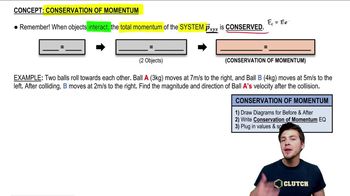
The principle of conservation of momentum states that in a closed system, the total momentum before an event must equal the total momentum after the event. In this scenario, the archer and the arrow form a closed system. When the arrow is shot, the momentum gained by the arrow must be equal and opposite to the momentum gained by the archer, leading to the calculation of the archer's recoil speed.
Recommended video:
Guided course
05:58
Conservation Of Momentum

Momentum

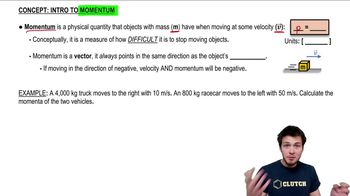
Momentum is defined as the product of an object's mass and its velocity, represented mathematically as p = mv. In this case, both the archer and the arrow have momentum, and their respective masses and velocities will determine how they move after the arrow is released. Understanding how to calculate momentum is crucial for solving the problem of the archer's recoil speed.
Recommended video:
Guided course
05:17
Intro to Momentum

Newton's Third Law of Motion

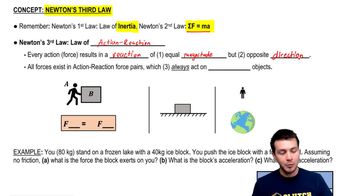
Newton's Third Law states that for every action, there is an equal and opposite reaction. When the archer shoots the arrow, the force exerted on the arrow results in an equal force acting on the archer in the opposite direction. This law is fundamental in understanding the interaction between the archer and the arrow, allowing us to determine the archer's recoil speed based on the force applied to the arrow.
Recommended video:
Guided course
08:01
Newton's Third Law & Action-Reaction Pairs
Related Practice
Textbook Question

An 85 kg cheerleader stands on a scale that reads in kg. What does the scale read if the 85 kg cheerleader lifts the 50 kg cheerleader upward with an acceleration of 2.0 m/s²?

1
views

Textbook Question

The 1.0 kg physics book in FIGURE P7.40 is connected by a string to a 500 g coffee cup. The book is given a push up the slope and released with a speed of 3.0 m/s. The coefficients of friction are μs = 0.50 and μk = 0.20. At the highest point, does the book stick to the slope, or does it slide back down?

1
views
Textbook Question

A house painter uses the chair-and-pulley arrangement of FIGURE P7.45 to lift himself up the side of a house. The painter's mass is 70 kg and the chair's mass is 10 kg. With what force must he pull down on the rope in order to accelerate upward at 0.20 m/s².

1
views
Textbook Question

Your forehead can withstand a force of about 6.0 kN before fracturing, while your cheekbone can withstand only about 1.3 kN. Suppose a 140 g baseball traveling at 30 m/s strikes your head and stops in 1.5 ms. What is the magnitude of the force that stops the baseball?

1
views
Textbook Question

A 2.0 kg block on a horizontal, frictionless surface is connected by a massless spring and a massless, frictionless pulley to a hanging mass. For what value of the hanging mass does the block accelerate at 1.5 m/s²?

2
views
Textbook Question

A rope of length L and mass m is suspended from the ceiling. Find an expression for the tension in the rope at position y, measured upward from the free end of the rope.

1
views