Ch 07: Newton's Third Law
Knight Calc - Physics for Scientists and Engineers 5th Edition
Knight Calc5th EditionPhysics for Scientists and EngineersISBN: 9780137344796Not the one you use?Change textbook
Chapter 7, Problem 28

A rope of length L and mass m is suspended from the ceiling. Find an expression for the tension in the rope at position y, measured upward from the free end of the rope.

Verified step by step guidance
1
Start by understanding that the tension in the rope at a position y is due to the weight of the rope below that point. The weight of the rope below y depends on the mass of the rope segment below y.
The mass per unit length of the rope, also called the linear mass density, is \( \lambda = \frac{m}{L} \), where \( m \) is the total mass of the rope and \( L \) is its total length.
The length of the rope below the position y is \( L - y \). Therefore, the mass of the rope below y is \( \lambda (L - y) = \frac{m}{L}(L - y) \).
The weight of the rope below y is the force due to gravity acting on this mass, which is \( F = \text{mass} \times g = \frac{m}{L}(L - y)g \), where \( g \) is the acceleration due to gravity.
The tension at position y is equal to the weight of the rope below that point. Thus, the tension is given by \( T(y) = \frac{m}{L}(L - y)g \).

Verified video answer for a similar problem:

This video solution was recommended by our tutors as helpful for the problem above.
Video duration:
6m
Was this helpful?

Key Concepts

Here are the essential concepts you must grasp in order to answer the question correctly.

Tension in a Rope

Tension is the force exerted along the length of a rope or string when it is pulled tight by forces acting from opposite ends. In a hanging rope, the tension varies along its length due to the weight of the rope itself. The tension at any point in the rope must balance the weight of the rope below that point.
Recommended video:
Guided course
06:34
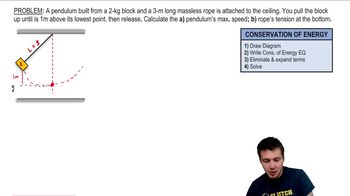
Calculating Tension in a Pendulum with Energy Conservation

Weight of the Rope

The weight of the rope is the force due to gravity acting on its mass, calculated as W = mg, where m is the mass of the rope and g is the acceleration due to gravity. This weight contributes to the tension experienced at different points along the rope, as the tension must support not only the segment of the rope above a given point but also the weight of the rope below that point.
Recommended video:
Guided course
10:19
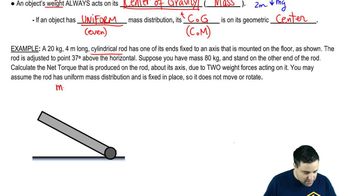
Torque Due to Weight

Static Equilibrium

Static equilibrium refers to a state where an object is at rest and the sum of forces acting on it is zero. In the context of the rope, this means that at any point along the rope, the upward tension force must equal the downward gravitational force acting on the segment of the rope below that point. This principle allows us to derive expressions for tension based on the position along the rope.
Recommended video:
Guided course
08:11
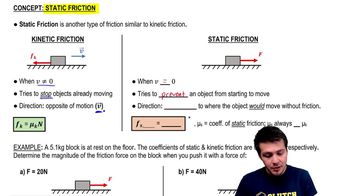
Static Friction & Equilibrium
Related Practice
Textbook Question

An 85 kg cheerleader stands on a scale that reads in kg. What does the scale read if the 85 kg cheerleader lifts the 50 kg cheerleader upward with an acceleration of 2.0 m/s²?

1
views

Textbook Question

A 75 kg archer on ice skates is standing at rest on very smooth ice. He shoots a 450 g arrow horizontally. When released, the arrow reaches a speed of 110 m/s in 0.25 s. Assume that the force of the bow string on the arrow is constant. What is the archer's recoil speed?

1
views
Textbook Question

The 100 kg block in FIGURE EX7.24 takes 6.0 s to reach the floor after being released from rest. What is the mass of the block on the left? The pulley is massless and frictionless.

2
views
Textbook Question

Two blocks are attached to opposite ends of a massless rope that goes over a massless, frictionless, stationary pulley. One of the blocks, with a mass of 6.0 kg, accelerates downward at (3/4)g. What is the mass of the other block?

2
views
Textbook Question

Your forehead can withstand a force of about 6.0 kN before fracturing, while your cheekbone can withstand only about 1.3 kN. Suppose a 140 g baseball traveling at 30 m/s strikes your head and stops in 1.5 ms. What is the magnitude of the force that stops the baseball?

1
views
Textbook Question

The 1.0 kg block in FIGURE EX7.23 is tied to the wall with a rope. It sits on top of the 2.0 kg block. The lower block is pulled to the right with a tension force of 20 N. The coefficient of kinetic friction at both the lower and upper surfaces of the 2.0 kg block is μk = 0.40. What is the tension in the rope attached to the wall?

2
views