Ch 04: Kinematics in Two Dimensions
Knight Calc - Physics for Scientists and Engineers 5th Edition
Knight Calc5th EditionPhysics for Scientists and EngineersISBN: 9780137344796Not the one you use?Change textbook
Chapter 4, Problem 54

You are watching an archery tournament when you start wondering how fast an arrow is shot from the bow. Remembering your physics, you ask one of the archers to shoot an arrow parallel to the ground. You find the arrow stuck in the ground 60 m away, making a 30° angle with the ground. How fast was the arrow shot?

Verified step by step guidance
1
Step 1: Break the problem into horizontal and vertical motion components. The arrow's motion can be analyzed as a projectile motion problem. The horizontal distance traveled by the arrow is 60 m, and the angle it makes with the ground upon impact is 30°. Assume the arrow was shot parallel to the ground, so the initial vertical velocity is 0 m/s.
Step 2: Use the angle of impact to determine the relationship between the horizontal and vertical velocities at the moment the arrow hits the ground. The tangent of the angle of impact is given by \( \tan(\theta) = \frac{v_y}{v_x} \), where \( v_y \) is the vertical velocity and \( v_x \) is the horizontal velocity. Here, \( \theta = 30° \).
Step 3: Relate the vertical velocity \( v_y \) to the time of flight using the kinematic equation for vertical motion: \( v_y = g \cdot t \), where \( g \) is the acceleration due to gravity (9.8 m/s²) and \( t \) is the time of flight. Combine this with the relationship from Step 2 to express \( t \) in terms of \( v_x \).
Step 4: Use the horizontal motion equation to find the time of flight. The horizontal distance traveled is given by \( x = v_x \cdot t \), where \( x = 60 \; \text{m} \). Solve for \( t \) in terms of \( v_x \).
Step 5: Combine the equations from Steps 3 and 4 to solve for \( v_x \), the horizontal velocity, which is also the initial velocity of the arrow since it was shot parallel to the ground. Substitute known values (\( g = 9.8 \; \text{m/s}^2 \), \( \tan(30°) \), and \( x = 60 \; \text{m} \)) to find the final expression for the initial velocity.

Verified video answer for a similar problem:

This video solution was recommended by our tutors as helpful for the problem above.
Video duration:
11m
Was this helpful?

Key Concepts

Here are the essential concepts you must grasp in order to answer the question correctly.

Projectile Motion

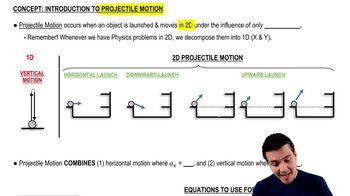
Projectile motion refers to the motion of an object that is launched into the air and is subject to gravitational forces. In this scenario, the arrow is shot parallel to the ground, and its trajectory can be analyzed using the principles of projectile motion, which includes horizontal and vertical components of motion.
Recommended video:
Guided course
04:44
Introduction to Projectile Motion

Kinematic Equations

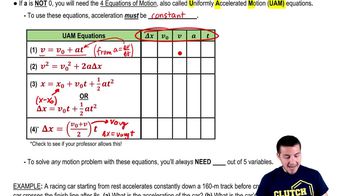
Kinematic equations describe the relationship between an object's displacement, initial velocity, final velocity, acceleration, and time. These equations are essential for solving problems involving motion, such as determining the initial speed of the arrow based on its horizontal distance traveled and the angle at which it strikes the ground.
Recommended video:
Guided course
08:25
Kinematics Equations

Trigonometry in Physics

Trigonometry is a branch of mathematics that deals with the relationships between the angles and sides of triangles. In this context, trigonometric functions can be used to resolve the components of the arrow's motion, particularly when analyzing the angle at which it lands and relating it to its horizontal and vertical displacements.
Recommended video:
Guided course
3:26
Trigonometry