
Ch 04: Kinematics in Two Dimensions
Knight Calc - Physics for Scientists and Engineers 5th Edition
Knight Calc5th EditionPhysics for Scientists and EngineersISBN: 9780137344796Not the one you use?Change textbook
Chapter 4, Problem 60b

Ships A and B leave port together. For the next two hours, ship A travels at 20 mph in a direction 30° west of north while ship B travels 20° east of north at 25 mph. What is the speed of ship A as seen by ship B?

Verified step by step guidance
1
Step 1: Break down the velocity vectors of both ships into their respective components. For ship A, calculate the northward and westward components of its velocity using trigonometric functions. The northward component is given by \( v_{A, \text{north}} = v_A \cdot \cos(30°) \), and the westward component is \( v_{A, \text{west}} = v_A \cdot \sin(30°) \). Similarly, for ship B, calculate the northward and eastward components using \( v_{B, \text{north}} = v_B \cdot \cos(20°) \) and \( v_{B, \text{east}} = v_B \cdot \sin(20°) \).
Step 2: Determine the relative velocity components of ship A as seen by ship B. Subtract the velocity components of ship B from those of ship A. For the northward direction, \( v_{\text{relative, north}} = v_{A, \text{north}} - v_{B, \text{north}} \). For the east-west direction, \( v_{\text{relative, east-west}} = v_{A, \text{west}} - (-v_{B, \text{east}}) \), since ship B's eastward velocity is opposite to ship A's westward velocity.
Step 3: Combine the relative velocity components to find the magnitude of the relative velocity. Use the Pythagorean theorem: \( v_{\text{relative}} = \sqrt{(v_{\text{relative, north}})^2 + (v_{\text{relative, east-west}})^2} \).
Step 4: If needed, calculate the direction of the relative velocity vector. Use the inverse tangent function: \( \theta_{\text{relative}} = \tan^{-1}\left(\frac{v_{\text{relative, east-west}}}{v_{\text{relative, north}}}\right) \). This gives the angle of the relative velocity vector with respect to the northward direction.
Step 5: Interpret the result. The magnitude calculated in Step 3 represents the speed of ship A as seen by ship B, and the direction calculated in Step 4 (if required) provides the orientation of the relative velocity vector.

Verified video answer for a similar problem:

This video solution was recommended by our tutors as helpful for the problem above.
Video duration:
14m
Was this helpful?

Key Concepts

Here are the essential concepts you must grasp in order to answer the question correctly.

Relative Velocity

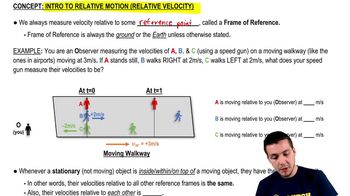
Relative velocity is the velocity of one object as observed from another moving object. It is calculated by subtracting the velocity vector of the observer from the velocity vector of the object being observed. This concept is crucial for understanding how the speed and direction of one ship appear from the perspective of another ship.
Recommended video:
Guided course
04:27
Intro to Relative Motion (Relative Velocity)

Vector Addition

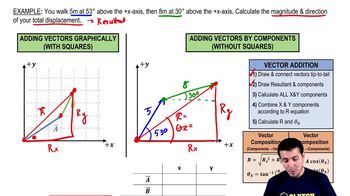
Vector addition involves combining two or more vectors to determine a resultant vector. In this context, the velocities of ships A and B must be represented as vectors, taking into account their magnitudes and directions. This process allows us to find the relative velocity of ship A as seen from ship B.
Recommended video:
Guided course
07:30
Vector Addition By Components

Trigonometry in Physics

Trigonometry is essential in physics for resolving vectors into their components. By using sine and cosine functions, we can break down the velocities of ships A and B into their northward and eastward components. This breakdown is necessary to accurately calculate the relative speed and direction of ship A from the perspective of ship B.
Recommended video:
Guided course
3:26
Trigonometry
Related Practice
Textbook Question

You are watching an archery tournament when you start wondering how fast an arrow is shot from the bow. Remembering your physics, you ask one of the archers to shoot an arrow parallel to the ground. You find the arrow stuck in the ground 60 m away, making a 30° angle with the ground. How fast was the arrow shot?

1
views
Textbook Question

While driving north at 25 m/s during a rainstorm you notice that the rain makes an angle of 38° with the vertical. While driving back home moments later at the same speed but in the opposite direction, you see that the rain is falling straight down. From these observations, determine the speed and angle of the raindrops relative to the ground.

1
views
Textbook Question

You're 6.0 m from one wall of the house seen in FIGURE P4.55. You want to toss a ball to your friend who is 6.0 m from the opposite wall. The throw and catch each occur 1.0 m above the ground. At what angle should you toss the ball?

3
views
Textbook Question

The angular velocity of a spinning gyroscope is measured every 0.5 s. The results and the best-fit line from a spreadsheet are shown in FIGURE P4.63. What is the gyroscope's initial angular velocity at t = 0 s?

1
views
Textbook Question

A cannonball is fired at 100 m/s from a barrel tilted upward at 25°. What is the angle after the cannonball travels 500 m?

Textbook Question

A ball rolling on a circular track, starting from rest, has angular acceleration α\(\alpha\). Find an expression, in terms of α\(\alpha\), for the time at which the ball's acceleration vector a is 4545^{\(\circ\)} away from a radial line toward the center of the circle.

1
views