
Ch 04: Kinematics in Two Dimensions
Knight Calc - Physics for Scientists and Engineers 5th Edition
Knight Calc5th EditionPhysics for Scientists and EngineersISBN: 9780137344796Not the one you use?Change textbook
Chapter 4, Problem 50c

A ball is thrown toward a cliff of height h with a speed of 30 m/s and an angle of 60° above horizontal. It lands on the edge of the cliff 4.0 s later. What is the ball's impact speed?

Verified step by step guidance
1
Step 1: Break the initial velocity into horizontal and vertical components. Use the equations: \( v_{x0} = v_0 \cos(\theta) \) and \( v_{y0} = v_0 \sin(\theta) \), where \( v_0 = 30 \, \text{m/s} \) and \( \theta = 60^\circ \).
Step 2: Calculate the vertical velocity at the time of impact using the kinematic equation: \( v_y = v_{y0} - g t \), where \( g = 9.8 \, \text{m/s}^2 \) and \( t = 4.0 \, \text{s} \).
Step 3: The horizontal velocity remains constant throughout the motion because there is no horizontal acceleration. Thus, \( v_x = v_{x0} \).
Step 4: Use the Pythagorean theorem to find the magnitude of the impact speed. The total speed is given by \( v = \sqrt{v_x^2 + v_y^2} \).
Step 5: Combine the results from Steps 2 and 3 into the equation from Step 4 to determine the ball's impact speed.

Verified video answer for a similar problem:

This video solution was recommended by our tutors as helpful for the problem above.
Video duration:
9m
Was this helpful?

Key Concepts

Here are the essential concepts you must grasp in order to answer the question correctly.

Projectile Motion

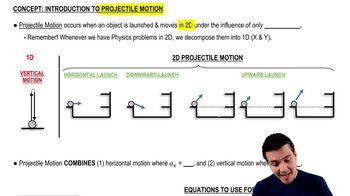
Projectile motion refers to the motion of an object that is launched into the air and is subject to gravitational forces. It can be analyzed by breaking it into horizontal and vertical components. The horizontal motion is uniform, while the vertical motion is influenced by gravity, leading to a parabolic trajectory. Understanding these components is essential for calculating the object's position and speed at any point in time.
Recommended video:
Guided course
04:44
Introduction to Projectile Motion

Kinematic Equations

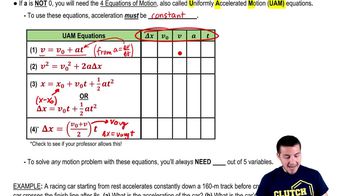
Kinematic equations describe the relationships between an object's displacement, velocity, acceleration, and time. For projectile motion, these equations can be applied separately to the horizontal and vertical components. They allow us to calculate final velocities and positions based on initial conditions and the effects of gravity, which is crucial for determining the impact speed of the ball in this scenario.
Recommended video:
Guided course
08:25
Kinematics Equations

Vector Addition

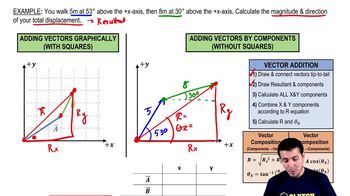
Vector addition is the process of combining two or more vectors to determine a resultant vector. In the context of projectile motion, the velocity of the ball just before impact can be found by adding its horizontal and vertical velocity components. Since these components are perpendicular to each other, the Pythagorean theorem is used to find the magnitude of the resultant velocity, which represents the ball's impact speed.
Recommended video:
Guided course
07:30
Vector Addition By Components