Ch. 25 - Electric Current and Resistance
Giancoli Douglas - Physics for Scientists and Engineers 5th edition
Giancoli Douglas5th editionPhysics for Scientists and EngineersISBN: 9780137488179Not the one you use?Change textbook
Chapter 24, Problem 8b

A 12-V battery causes a current of 0.50 A through a resistor. How many joules of energy does the battery lose in a minute?

Verified step by step guidance
1
Identify the formula to calculate the energy lost by the battery. The energy lost (E) is given by the formula: E = V I t, where V is the voltage, I is the current, and t is the time.
Substitute the given values into the formula. The voltage V is 12 V, the current I is 0.50 A, and the time t is 1 minute (convert this to seconds: 1 \, \(\text{minute}\) = 60 \, \(\text{seconds}\)).
Write the substituted equation: E = (12) (0.50) (60). This represents the energy lost in joules.
Simplify the multiplication to find the total energy lost. Perform the calculation step by step: first multiply the voltage and current, then multiply the result by the time.
The final result will give the energy lost by the battery in joules. Ensure the units are consistent throughout the calculation to confirm the result is in joules.

Verified video answer for a similar problem:

This video solution was recommended by our tutors as helpful for the problem above.
Video duration:
2m
Was this helpful?

Key Concepts

Here are the essential concepts you must grasp in order to answer the question correctly.

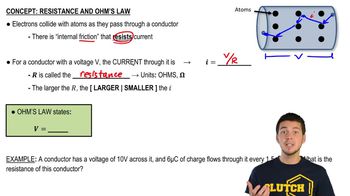
Ohm's Law

Ohm's Law states that the current (I) flowing through a conductor between two points is directly proportional to the voltage (V) across the two points and inversely proportional to the resistance (R) of the conductor. It is mathematically expressed as V = I × R. This principle is fundamental in understanding how voltage, current, and resistance interact in electrical circuits.
Recommended video:
Guided course
03:07
Resistance and Ohm's Law

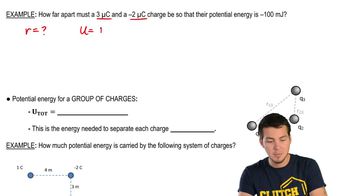
Electrical Energy

Electrical energy is the energy derived from electric potential energy or kinetic energy of charged particles. It can be calculated using the formula E = V × I × t, where E is energy in joules, V is voltage in volts, I is current in amperes, and t is time in seconds. This concept is crucial for determining how much energy is consumed or lost in electrical systems.
Recommended video:
Guided course
07:51
Electric Potential Energy

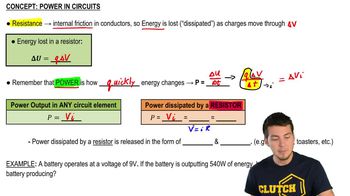
Power in Electrical Circuits

Power in electrical circuits is the rate at which electrical energy is transferred by an electric circuit. It is calculated using the formula P = V × I, where P is power in watts, V is voltage in volts, and I is current in amperes. Understanding power is essential for analyzing how much energy is used over time, which directly relates to the energy loss of the battery in the given scenario.
Recommended video:
Guided course
06:18
Power in Circuits