Ch. 25 - Electric Current and Resistance
Giancoli Douglas - Physics for Scientists and Engineers 5th edition
Giancoli Douglas5th editionPhysics for Scientists and EngineersISBN: 9780137488179Not the one you use?Change textbook
Chapter 24, Problem 7

(a) What is the current in the 13-Ω heating element of a 240-V clothes dryer?
(b) How much charge passes through the element in 15 min? (Assume direct current.)

Verified step by step guidance
1
Step 1: Use Ohm's Law to calculate the current in the heating element. Ohm's Law is given by \( I = \frac{V}{R} \), where \( I \) is the current, \( V \) is the voltage, and \( R \) is the resistance. Substitute \( V = 240 \, \text{V} \) and \( R = 13 \, \Omega \) into the formula.
Step 2: Once the current \( I \) is determined, calculate the total charge \( Q \) that passes through the element using the relationship \( Q = I \cdot t \), where \( t \) is the time in seconds. Convert the given time of 15 minutes into seconds by multiplying by 60 (\( t = 15 \cdot 60 \)).
Step 3: Substitute the value of \( I \) (calculated in Step 1) and \( t \) (calculated in Step 2) into the formula \( Q = I \cdot t \) to find the total charge.
Step 4: Ensure that the units are consistent throughout the calculations. Voltage is in volts (V), resistance is in ohms (\( \Omega \)), current is in amperes (A), time is in seconds (s), and charge is in coulombs (C).
Step 5: Review the calculations to ensure accuracy and verify that the results align with the physical principles of direct current circuits.

Verified video answer for a similar problem:

This video solution was recommended by our tutors as helpful for the problem above.
Video duration:
7m
Was this helpful?

Key Concepts

Here are the essential concepts you must grasp in order to answer the question correctly.

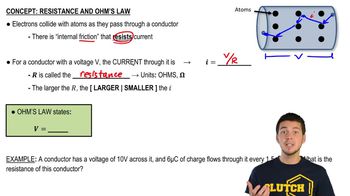
Ohm's Law

Ohm's Law states that the current (I) flowing through a conductor between two points is directly proportional to the voltage (V) across the two points and inversely proportional to the resistance (R) of the conductor. It is mathematically expressed as I = V/R. This principle is fundamental for calculating the current in electrical circuits, such as the heating element in the clothes dryer.
Recommended video:
Guided course
03:07
Resistance and Ohm's Law

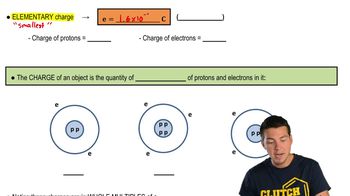
Electric Charge

Electric charge is a physical property of matter that causes it to experience a force when placed in an electromagnetic field. The unit of charge is the coulomb (C). In the context of the question, the total charge (Q) that passes through the heating element can be calculated using the formula Q = I × t, where I is the current and t is the time in seconds.
Recommended video:
Guided course
05:37
Electric Charge

Direct Current (DC)

Direct current (DC) is the unidirectional flow of electric charge, meaning that the electric charge flows in a constant direction. This is in contrast to alternating current (AC), where the flow of charge periodically reverses direction. In the context of the clothes dryer, assuming direct current simplifies the calculations for current and charge over time, as the values remain constant.
Recommended video:
09:49
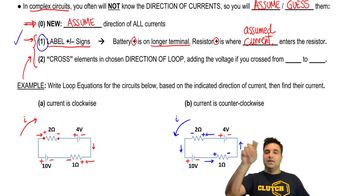
Direction of Current in Loop Equations