Ch. 25 - Electric Current and Resistance
Giancoli Douglas - Physics for Scientists and Engineers 5th edition
Giancoli Douglas5th editionPhysics for Scientists and EngineersISBN: 9780137488179Not the one you use?Change textbook
Chapter 24, Problem 1

What voltage will produce 0.25 A of current through a 5400-Ω resistor?

Verified step by step guidance
1
Identify the relationship between voltage, current, and resistance using Ohm's Law: \( V = I \cdot R \), where \( V \) is the voltage, \( I \) is the current, and \( R \) is the resistance.
Substitute the given values into the formula: \( I = 0.25 \; \text{A} \) and \( R = 5400 \; \Omega \). The equation becomes \( V = 0.25 \cdot 5400 \).
Perform the multiplication to calculate the voltage. This step involves multiplying the current (in amperes) by the resistance (in ohms).
Ensure the units are consistent: amperes for current, ohms for resistance, and volts for voltage. The result will be in volts.
The calculated voltage represents the potential difference required to produce the given current through the resistor.

Verified video answer for a similar problem:

This video solution was recommended by our tutors as helpful for the problem above.
Video duration:
1m
Was this helpful?

Key Concepts

Here are the essential concepts you must grasp in order to answer the question correctly.

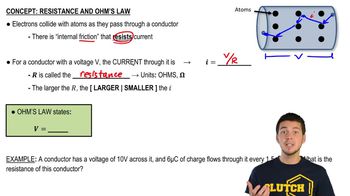
Ohm's Law

Ohm's Law is a fundamental principle in electronics that relates voltage (V), current (I), and resistance (R) in a circuit. It states that V = I × R, meaning the voltage across a resistor is equal to the product of the current flowing through it and the resistance. This law is essential for calculating the voltage required to achieve a specific current in a resistor.
Recommended video:
Guided course
03:07
Resistance and Ohm's Law

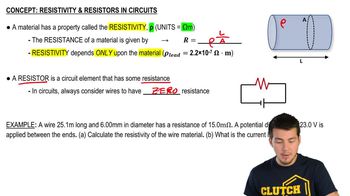
Resistance

Resistance is a measure of the opposition to the flow of electric current in a conductor. It is measured in ohms (Ω) and depends on the material, length, and cross-sectional area of the conductor. In the context of the question, the 5400-Ω resistor indicates how much it resists the flow of current, which directly affects the voltage needed to achieve a certain current.
Recommended video:
Guided course
05:25
Resistivity & Resistors in Circuits

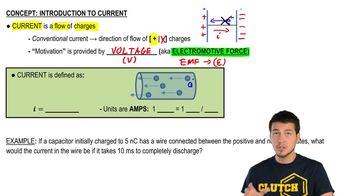
Current

Current is the flow of electric charge in a circuit, measured in amperes (A). It represents the rate at which charge is flowing through a conductor. In this question, a current of 0.25 A is specified, and understanding how current interacts with voltage and resistance is crucial for determining the necessary voltage to achieve this current through the given resistor.
Recommended video:
Guided course
05:38
Intro to Current