Ch. 25 - Electric Current and Resistance
Giancoli Douglas - Physics for Scientists and Engineers 5th edition
Giancoli Douglas5th editionPhysics for Scientists and EngineersISBN: 9780137488179Not the one you use?Change textbook
Chapter 24, Problem 21

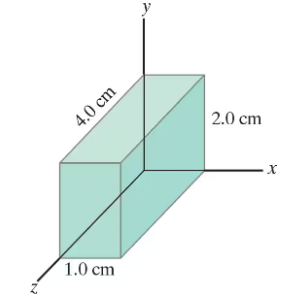
A rectangular solid made of carbon has sides of lengths 1.0 cm, 2.0 cm, and 4.0 cm, lying along the x, y, and z axes, respectively (Fig. 25–36). Determine the resistance for current that passes through the solid in the y direction, (Assume the resistivity is ρ = 3.0 x 10⁻⁵ Ω•m).
Rectangular carbon solid with dimensions 1.0 cm (z), 2.0 cm (x), and 4.0 cm (y) oriented along the axes.

Verified step by step guidance
1
Identify the formula for resistance in terms of resistivity: \( R = \frac{\rho \cdot L}{A} \), where \( R \) is the resistance, \( \rho \) is the resistivity, \( L \) is the length of the material in the direction of current flow, and \( A \) is the cross-sectional area perpendicular to the current flow.
Determine the length \( L \) in the direction of current flow. Since the current flows in the y-direction, \( L = 2.0 \; \text{cm} \) or \( 0.02 \; \text{m} \).
Calculate the cross-sectional area \( A \) perpendicular to the y-direction. The cross-section is formed by the sides along the x and z axes, so \( A = \text{length along x} \times \text{length along z} = 1.0 \; \text{cm} \times 4.0 \; \text{cm} = 4.0 \; \text{cm}^2 \) or \( 4.0 \times 10^{-6} \; \text{m}^2 \).
Substitute the given values into the resistance formula: \( R = \frac{\rho \cdot L}{A} \), where \( \rho = 3.0 \times 10^{-5} \; \Omega \cdot \text{m} \), \( L = 0.02 \; \text{m} \), and \( A = 4.0 \times 10^{-6} \; \text{m}^2 \).
Simplify the expression to find the resistance \( R \). Ensure the units are consistent throughout the calculation to obtain the resistance in ohms (\( \Omega \)).

Verified video answer for a similar problem:

This video solution was recommended by our tutors as helpful for the problem above.
Video duration:
7m
Was this helpful?

Key Concepts

Here are the essential concepts you must grasp in order to answer the question correctly.

Resistivity

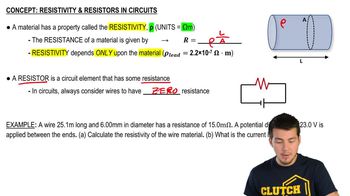
Resistivity is a material property that quantifies how strongly a given material opposes the flow of electric current. It is denoted by the symbol ρ (rho) and is measured in ohm-meters (Ω·m). The resistivity of a material depends on its composition and temperature, and it plays a crucial role in determining the resistance of a conductor when its dimensions are known.
Recommended video:
Guided course
05:25
Resistivity & Resistors in Circuits

Resistance

Resistance is a measure of the opposition to the flow of electric current in a conductor. It is calculated using the formula R = ρ(L/A), where R is resistance, ρ is resistivity, L is the length of the conductor, and A is its cross-sectional area. The resistance varies with the shape and size of the conductor, as well as the material's resistivity.
Recommended video:
Guided course
05:25
Resistivity & Resistors in Circuits

Geometric Orientation

Geometric orientation refers to the alignment and dimensions of a solid object in relation to the flow of current. In this case, the rectangular solid's dimensions along the x, y, and z axes affect how current flows through it. Understanding the orientation is essential for calculating resistance, as it determines the effective length and cross-sectional area through which the current passes.
Recommended video:
Guided course
05:30
Magnetic Fields and Magnetic Dipoles
Related Practice