Ch. 25 - Electric Current and Resistance
Giancoli Douglas - Physics for Scientists and Engineers 5th edition
Giancoli Douglas5th editionPhysics for Scientists and EngineersISBN: 9780137488179Not the one you use?Change textbook
Chapter 24, Problem 31

An electric car uses a 45-kW (160-hp) motor. If the battery pack is designed for 340 V, what current would the motor need to draw from the battery? Neglect any energy losses in getting energy from the battery to the motor.

Verified step by step guidance
1
Step 1: Identify the given values in the problem. The power of the motor is given as 45 kW (kilowatts), which can be written as \( P = 45000 \, \text{W} \). The voltage of the battery pack is \( V = 340 \, \text{V} \).
Step 2: Recall the relationship between power, voltage, and current. The formula is \( P = IV \), where \( P \) is power, \( I \) is current, and \( V \) is voltage.
Step 3: Rearrange the formula to solve for current \( I \). This gives \( I = \frac{P}{V} \).
Step 4: Substitute the known values into the formula. Replace \( P \) with \( 45000 \, \text{W} \) and \( V \) with \( 340 \, \text{V} \). The equation becomes \( I = \frac{45000}{340} \).
Step 5: Simplify the expression to find the current \( I \). Perform the division to calculate the current in amperes (A).

Verified video answer for a similar problem:

This video solution was recommended by our tutors as helpful for the problem above.
Video duration:
1m
Was this helpful?

Key Concepts

Here are the essential concepts you must grasp in order to answer the question correctly.

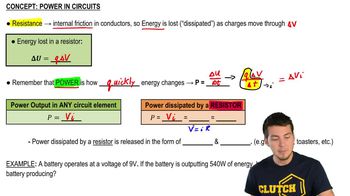
Power in Electrical Circuits

Power in electrical circuits is defined as the rate at which electrical energy is transferred by an electric circuit. It is calculated using the formula P = IV, where P is power in watts, I is current in amperes, and V is voltage in volts. In this context, the motor's power rating of 45 kW indicates how much energy it consumes per unit time.
Recommended video:
Guided course
06:18
Power in Circuits

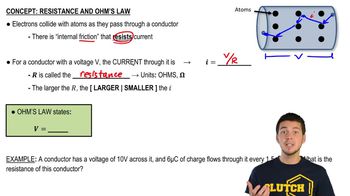
Ohm's Law

Ohm's Law is a fundamental principle in electronics that relates voltage (V), current (I), and resistance (R) in a circuit. It states that V = IR, meaning the voltage across a conductor is directly proportional to the current flowing through it, provided the temperature remains constant. This law is essential for understanding how current can be calculated when voltage and power are known.
Recommended video:
Guided course
03:07
Resistance and Ohm's Law

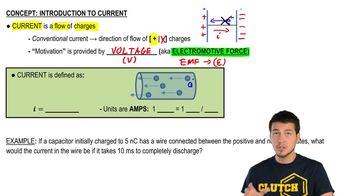
Current Calculation

To find the current drawn by an electric motor, we can rearrange the power formula to I = P/V. This means that the current can be determined by dividing the power (in watts) by the voltage (in volts). In this scenario, knowing the motor's power and the battery voltage allows us to calculate the current required for the motor to operate efficiently.
Recommended video:
Guided course
05:38
Intro to Current
Related Practice
Textbook Question

You buy a 75-W lightbulb in Europe, where electricity is delivered at 240 V. If you use the bulb in the United States at 120 V (assume its resistance does not change), how bright will it be relative to 75-W 120-V bulbs? [Hint: Assume roughly that brightness is proportional to power consumed.]

1
views
Textbook Question

The filament of an incandescent lightbulb has a resistance of 12 Ω at 20°C and 140 Ω when hot.

(a) Calculate the temperature of the filament when it is hot, and take into account the change in length and area of the filament due to thermal expansion (assume tungsten for which the thermal expansion coefficient is ≈ 5.5 10⁻⁶ C°⁻¹ ).

(b) In this temperature range, what is the percentage change in resistance due to thermal expansion, and what is the percentage change in resistance due solely to the change in ρ? Use Eq. 25–5.

2
views
Textbook Question

A flashlight uses two AA 1.5-V batteries connected in series to provide 3.0 V across the bulb, as in Fig. 25–4b. The bulb draws 135 mA when turned on.

(a) Calculate the resistance of the bulb and the power dissipated.

(b) By what factor would the power increase if four AA batteries in series (total 6.0 V) were used with the same bulb? (Neglect heating effects of the filament.) Why shouldn’t you try this?

2
views
Textbook Question

At \$0.12/kWh, what does it cost to leave a 25-W porch light on day and night for a year?

1
views
Textbook Question

A rectangular solid made of carbon has sides of lengths 1.0 cm, 2.0 cm, and 4.0 cm, lying along the x, y, and z axes, respectively (Fig. 25–36). Determine the resistance for current that passes through the solid in the y direction, (Assume the resistivity is ρ = 3.0 x 10⁻⁵ Ω•m).

1
views
Textbook Question

The heating element of an electric oven is designed to produce 3.1 kW of heat when connected to a 240-V source. What must be the resistance of the element?

2
views