
Textbook Question
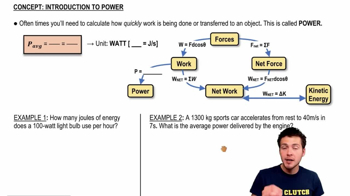
An electric car uses a 45-kW (160-hp) motor. If the battery pack is designed for 340 V, what current would the motor need to draw from the battery? Neglect any energy losses in getting energy from the battery to the motor.
1
views

 Verified step by step guidance
 06:00
06:00
 03:07
03:07 07:14
07:14An electric car uses a 45-kW (160-hp) motor. If the battery pack is designed for 340 V, what current would the motor need to draw from the battery? Neglect any energy losses in getting energy from the battery to the motor.
The filament of an incandescent lightbulb has a resistance of 12 Ω at 20°C and 140 Ω when hot.
(a) Calculate the temperature of the filament when it is hot, and take into account the change in length and area of the filament due to thermal expansion (assume tungsten for which the thermal expansion coefficient is ≈ 5.5 10⁻⁶ C°⁻¹ ).
(b) In this temperature range, what is the percentage change in resistance due to thermal expansion, and what is the percentage change in resistance due solely to the change in ρ? Use Eq. 25–5.
A flashlight uses two AA 1.5-V batteries connected in series to provide 3.0 V across the bulb, as in Fig. 25–4b. The bulb draws 135 mA when turned on.
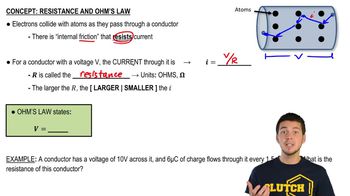
(a) Calculate the resistance of the bulb and the power dissipated.
(b) By what factor would the power increase if four AA batteries in series (total 6.0 V) were used with the same bulb? (Neglect heating effects of the filament.) Why shouldn’t you try this?
At \$0.12/kWh, what does it cost to leave a 25-W porch light on day and night for a year?
The heating element of an electric oven is designed to produce 3.1 kW of heat when connected to a 240-V source. What must be the resistance of the element?
(II) A power station delivers 750 kW of power at 12,000 V to a factory through wires with total resistance 3.0 Ω. How much less power is wasted if the electricity is delivered at 50,000 V rather than 12,000 V?