
Ch. 25 - Electric Current and Resistance
Giancoli Douglas - Physics for Scientists and Engineers 5th edition
Giancoli Douglas5th editionPhysics for Scientists and EngineersISBN: 9780137488179Not the one you use?Change textbook
Chapter 24, Problem 41

(II) A power station delivers 750 kW of power at 12,000 V to a factory through wires with total resistance 3.0 Ω. How much less power is wasted if the electricity is delivered at 50,000 V rather than 12,000 V?

Verified step by step guidance
1
Step 1: Calculate the current (I) in the circuit when the power is delivered at 12,000 V. Use the formula for power: P=VI, where P is the power (750 kW) and V is the voltage (12,000 V). Rearrange to find I=P/V.
Step 2: Calculate the power wasted in the wires when the voltage is 12,000 V. Use the formula for power loss due to resistance: Ploss=I2R, where I is the current calculated in Step 1 and R is the total resistance of the wires (3.0 Ω).
Step 3: Repeat Step 1 to calculate the current (I) when the power is delivered at 50,000 V. Use the same formula: I=P/V, but substitute 50,000 V for the voltage.
Step 4: Calculate the power wasted in the wires when the voltage is 50,000 V. Again, use the formula Ploss=I2R, but use the current calculated in Step 3.
Step 5: Find the difference in power wasted between the two cases. Subtract the power loss at 50,000 V from the power loss at 12,000 V to determine how much less power is wasted when the electricity is delivered at the higher voltage.

Verified video answer for a similar problem:

This video solution was recommended by our tutors as helpful for the problem above.
Video duration:
8m
Was this helpful?

Key Concepts

Here are the essential concepts you must grasp in order to answer the question correctly.

Power and Voltage Relationship

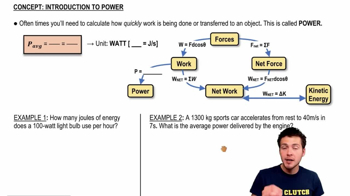
The relationship between power (P), voltage (V), and current (I) is defined by the equation P = VI. This means that for a given power output, increasing the voltage allows for a decrease in current, which is crucial for minimizing energy losses in transmission lines.
Recommended video:

Ohm's Law

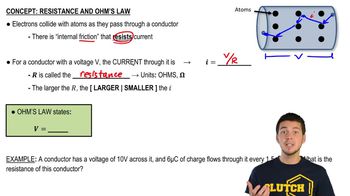
Ohm's Law states that the current (I) flowing through a conductor between two points is directly proportional to the voltage (V) across the two points and inversely proportional to the resistance (R) of the conductor, expressed as V = IR. This principle helps in understanding how resistance affects power loss in electrical systems.
Recommended video:
Guided course
03:07
Resistance and Ohm's Law

Power Loss in Transmission Lines

Power loss in transmission lines is primarily due to the resistance of the wires, calculated using the formula P_loss = I²R. As current increases, the power lost as heat in the wires also increases, making high-voltage transmission more efficient by reducing current and thus minimizing losses.
Recommended video: