Ch. 25 - Electric Current and Resistance
Giancoli Douglas - Physics for Scientists and Engineers 5th edition
Giancoli Douglas5th editionPhysics for Scientists and EngineersISBN: 9780137488179Not the one you use?Change textbook
Chapter 24, Problem 54b

A heater coil connected to a 240-Vᵣₘₛ ac line has a resistance of 32Ω. What are the maximum and minimum values of the instantaneous power?

Verified step by step guidance
1
Step 1: Understand the relationship between the root mean square (RMS) voltage and the peak voltage in an AC circuit. The peak voltage \( V_{\text{peak}} \) is related to the RMS voltage \( V_{\text{rms}} \) by the equation \( V_{\text{peak}} = \sqrt{2} \cdot V_{\text{rms}} \). Use this formula to calculate the peak voltage.
Step 2: Recall the formula for instantaneous power in an AC circuit: \( P(t) = \frac{V^2(t)}{R} \), where \( V(t) \) is the instantaneous voltage and \( R \) is the resistance. The instantaneous voltage \( V(t) \) varies sinusoidally as \( V(t) = V_{\text{peak}} \cdot \sin(\omega t) \), where \( \omega \) is the angular frequency.
Step 3: Substitute \( V(t) = V_{\text{peak}} \cdot \sin(\omega t) \) into the power formula \( P(t) = \frac{V^2(t)}{R} \). This gives \( P(t) = \frac{(V_{\text{peak}} \cdot \sin(\omega t))^2}{R} = \frac{V_{\text{peak}}^2}{R} \cdot \sin^2(\omega t) \).
Step 4: Determine the maximum and minimum values of \( P(t) \). The maximum value of \( \sin^2(\omega t) \) is 1, and the minimum value is 0. Therefore, the maximum instantaneous power is \( P_{\text{max}} = \frac{V_{\text{peak}}^2}{R} \), and the minimum instantaneous power is \( P_{\text{min}} = 0 \).
Step 5: Use the value of \( V_{\text{peak}} \) calculated in Step 1 and the given resistance \( R = 32 \ \Omega \) to express \( P_{\text{max}} \) as \( P_{\text{max}} = \frac{(\sqrt{2} \cdot V_{\text{rms}})^2}{R} = \frac{2 \cdot V_{\text{rms}}^2}{R} \). Substitute \( V_{\text{rms}} = 240 \ \text{V} \) to find the numerical value of \( P_{\text{max}} \).

Verified video answer for a similar problem:

This video solution was recommended by our tutors as helpful for the problem above.
Video duration:
5m
Was this helpful?

Key Concepts

Here are the essential concepts you must grasp in order to answer the question correctly.

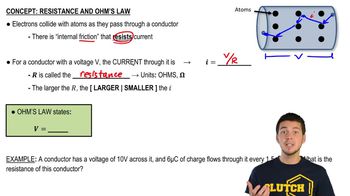
Ohm's Law

Ohm's Law states that the current (I) flowing through a conductor between two points is directly proportional to the voltage (V) across the two points and inversely proportional to the resistance (R) of the conductor. This relationship is expressed as V = IR. Understanding this law is crucial for calculating the current in the heater coil when connected to the AC voltage source.
Recommended video:
Guided course
03:07
Resistance and Ohm's Law

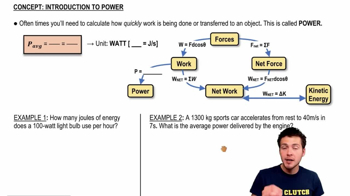
Instantaneous Power

Instantaneous power in an electrical circuit is defined as the product of the instantaneous voltage and the instantaneous current at any given moment. For AC circuits, this can be expressed as P(t) = V(t) * I(t). The maximum and minimum values of instantaneous power can be derived from the peak values of voltage and current, which vary sinusoidally over time.
Recommended video:

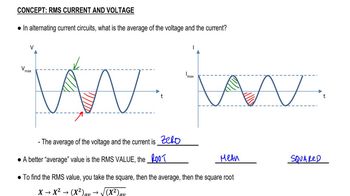
RMS Voltage

RMS (Root Mean Square) voltage is a statistical measure of the magnitude of a varying voltage. For AC circuits, it represents the equivalent DC voltage that would deliver the same power to a load. The RMS value of a sinusoidal voltage is calculated as V_rms = V_peak / √2. In this question, the 240 V_rms is essential for determining the peak voltage and subsequently the maximum instantaneous power.
Recommended video:
Guided course
07:14
RMS Current and Voltage