Ch. 20 - Second Law of Thermodynamics
Giancoli Douglas - Physics for Scientists and Engineers 5th edition
Giancoli Douglas5th editionPhysics for Scientists and EngineersISBN: 9780137488179Not the one you use?Change textbook
Chapter 20, Problem 17

A particular car does work at the rate of about 7.0 kJ/s when traveling at a steady 21.8 m/s along a level road. This is the work done against friction. The car can travel 17 km on 1.0 L of gasoline at this speed (about 40 mi/gal). What is the minimum value for TH if TL is 25°C? The energy available from 1.0 L of gas is 3.2 x 10⁷ J.

Verified step by step guidance
1
Step 1: Understand the problem. The car is performing work against friction at a rate of 7.0 kJ/s (7,000 J/s) while traveling at a steady speed. The energy available from 1.0 L of gasoline is 3.2 × 10⁷ J. The goal is to find the minimum value of the high-temperature reservoir (T_H) for a Carnot engine, given that the low-temperature reservoir (T_L) is 25°C (convert this to Kelvin: T_L = 25 + 273 = 298 K).
Step 2: Recall the Carnot efficiency formula. The efficiency (η) of a Carnot engine is given by: η = 1 - (T_L / T_H), where T_L and T_H are the temperatures of the low- and high-temperature reservoirs, respectively, in Kelvin. Rearrange this formula to solve for T_H: T_H = T_L / (1 - η).
Step 3: Calculate the efficiency (η). Efficiency is defined as the ratio of useful work output to the total energy input. Here, the useful work output is the work done against friction (7,000 J/s), and the total energy input is the energy provided by the gasoline per second. To find the energy input per second, divide the total energy available from 1.0 L of gasoline (3.2 × 10⁷ J) by the total time the car can run on 1.0 L of gasoline. First, calculate the total time: time = distance / speed = 17,000 m / 21.8 m/s.
Step 4: Use the total time to find the energy input per second. Once you have the total time, calculate the energy input per second (power input) by dividing the total energy (3.2 × 10⁷ J) by the total time. Then, calculate the efficiency (η) using the formula: η = (useful work output) / (energy input per second).
Step 5: Substitute the values of η and T_L into the rearranged Carnot efficiency formula to find T_H. Use T_H = T_L / (1 - η), where T_L = 298 K and η is the efficiency calculated in the previous step. This will give you the minimum value of T_H in Kelvin.

Verified video answer for a similar problem:

This video solution was recommended by our tutors as helpful for the problem above.
Video duration:
6m
Was this helpful?

Key Concepts

Here are the essential concepts you must grasp in order to answer the question correctly.

Work and Power

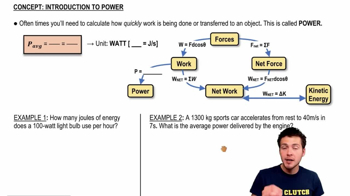
Work is defined as the energy transferred when a force is applied to an object over a distance. Power, on the other hand, is the rate at which work is done, measured in watts (or joules per second). In this scenario, the car does work against friction at a rate of 7.0 kJ/s, indicating the power required to maintain its speed against resistive forces.
Recommended video:

Thermodynamics and Heat Engines

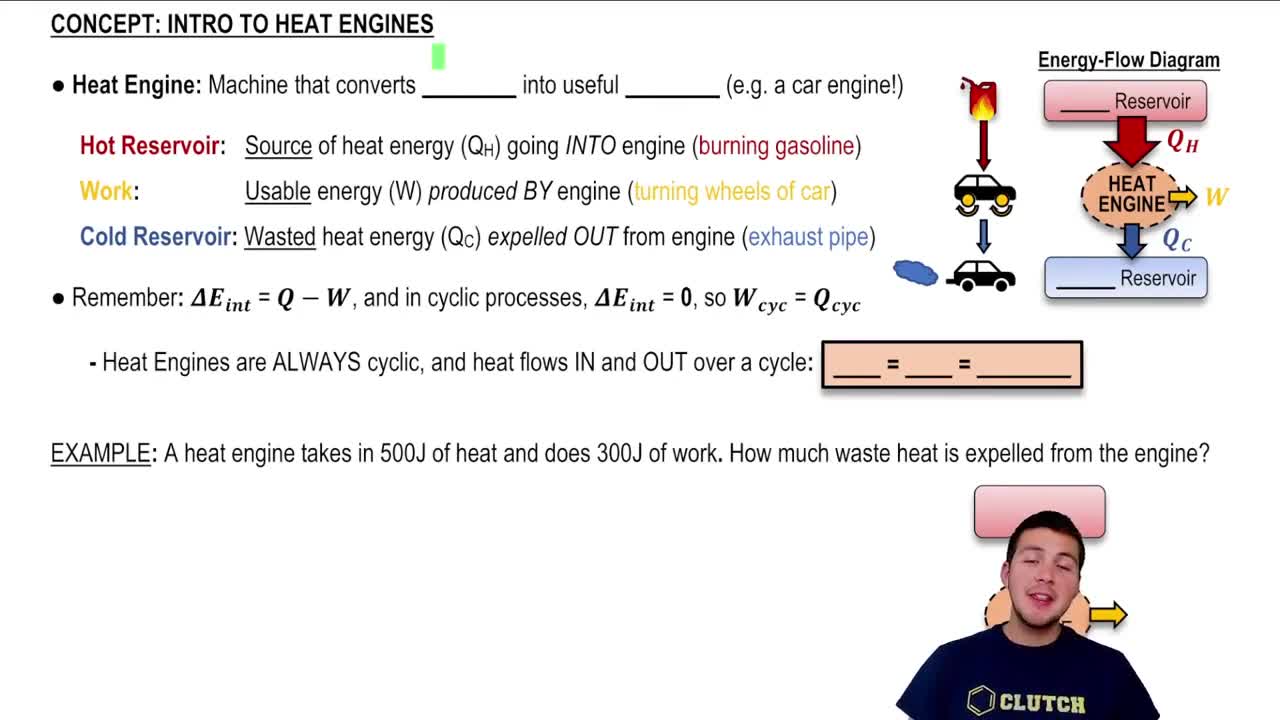
Thermodynamics is the branch of physics that deals with heat, work, and energy transformations. In the context of heat engines, the efficiency of converting thermal energy into work is determined by the temperatures of the hot and cold reservoirs (T_H and T_L). The minimum value for T_H can be calculated using the Carnot efficiency formula, which relates these temperatures to the work output of the engine.
Recommended video:
Guided course
07:35
Introduction to Heat Engines

Energy Content of Fuels

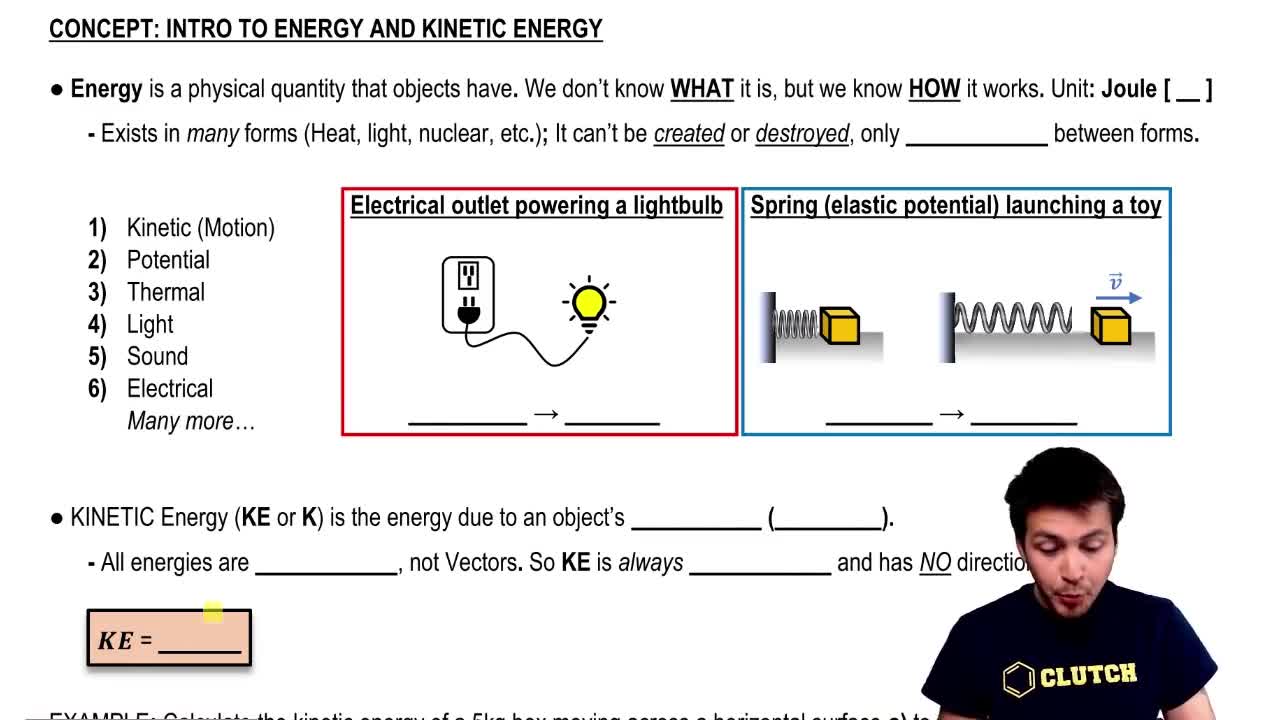
The energy content of fuels, such as gasoline, is a measure of the amount of energy released when the fuel is burned. In this case, 1.0 L of gasoline provides 3.2 x 10⁷ J of energy. Understanding this energy content is crucial for calculating the efficiency of the car's engine and determining how much work can be done with the available fuel.
Recommended video:
Guided course
04:10
Intro to Energy & Types of Energy
Related Practice
Textbook Question

One mole of monatomic gas undergoes a Carnot cycle with TH = 350°C and TL = 210°C. The initial pressure is 8.8 atm. During the isothermal expansion, the volume doubles. Find the values of the pressure and volume at the points a, b, c, and d of Fig. 20–5.

1
views
Textbook Question

(II) 1.00 mole of nitrogen (N₂) gas and 1.00 mole of argon (Ar) gas are in separate, equal-sized, insulated containers at the same temperature. The containers are then connected and the gases (assumed ideal) allowed to mix. What is the change in entropy

(a) of the system

1
views
Textbook Question

The working substance of a certain Carnot engine is 1.0 mol of an ideal monatomic gas. During the isothermal expansion portion of this engine’s cycle, the volume of the gas doubles, while during the adiabatic expansion the volume increases by a factor of 6.2. The work output of the engine is 920 J in each cycle. Compute the temperatures of the two reservoirs between which this engine operates.

Textbook Question

A four-cylinder gasoline engine has an efficiency of 0.22 and delivers 180 J of work per cycle per cylinder. If the engine runs at 25 cycles per second (1500 rpm), determine the total heat input per second from the gasoline.

1
views
Textbook Question

Assume that a 65-kg hiker needs to eat 4.0 x 10³ kcal of energy to supply a day’s worth of metabolism ( = QH). Estimate the elevation change the person can climb in one day, using only this amount of energy. As a fun and rough prediction, treat the person as an isolated heat engine, operating between the internal temperature of 37°C (98.6°F) and the ambient air temperature of 20°C.

1
views