Ch. 20 - Second Law of Thermodynamics
Giancoli Douglas - Physics for Scientists and Engineers 5th edition
Giancoli Douglas5th editionPhysics for Scientists and EngineersISBN: 9780137488179Not the one you use?Change textbook
Chapter 20, Problem 5b

A four-cylinder gasoline engine has an efficiency of 0.22 and delivers 180 J of work per cycle per cylinder. If the engine runs at 25 cycles per second (1500 rpm), determine the total heat input per second from the gasoline.

Verified step by step guidance
1
Step 1: Understand the problem. The engine has an efficiency of 0.22, meaning 22% of the heat input is converted into useful work. The work done per cycle per cylinder is 180 J, and the engine runs at 25 cycles per second. We need to calculate the total heat input per second from the gasoline.
Step 2: Calculate the total work done per second. Since the engine has four cylinders and operates at 25 cycles per second, the total work done per second is given by: \( W_{total} = 180 \text{ J/cycle/cylinder} \times 4 \text{ cylinders} \times 25 \text{ cycles/second} \).
Step 3: Use the efficiency formula to relate work and heat input. Efficiency \( \eta \) is defined as \( \eta = \frac{W_{total}}{Q_{input}} \), where \( W_{total} \) is the total work done per second and \( Q_{input} \) is the total heat input per second. Rearrange this formula to solve for \( Q_{input} \): \( Q_{input} = \frac{W_{total}}{\eta} \).
Step 4: Substitute the values into the formula. Use \( W_{total} \) calculated in Step 2 and \( \eta = 0.22 \) to find \( Q_{input} \). Ensure units are consistent throughout the calculation.
Step 5: Interpret the result. The calculated \( Q_{input} \) represents the total heat energy supplied to the engine per second from the gasoline. This value is crucial for understanding the energy consumption and efficiency of the engine.

Verified video answer for a similar problem:

This video solution was recommended by our tutors as helpful for the problem above.
Video duration:
3m
Was this helpful?

Key Concepts

Here are the essential concepts you must grasp in order to answer the question correctly.

Efficiency

Efficiency in a thermodynamic context refers to the ratio of useful work output to the total energy input. It is a measure of how well an engine converts fuel into work. In this case, the engine's efficiency of 0.22 indicates that 22% of the energy from the gasoline is converted into work, while the remaining 78% is lost as waste heat.
Recommended video:
Guided course
03:55
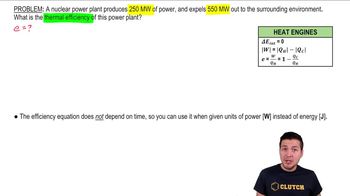
Efficiency of a Nuclear Power Plant

Work Done per Cycle

Work done per cycle is the amount of energy converted into useful work during one complete cycle of the engine. For this four-cylinder engine, it delivers 180 J of work per cycle per cylinder. Since there are four cylinders, the total work done per cycle for the engine is 720 J, which is crucial for calculating the total energy input required to achieve this output.
Recommended video:
Guided course
10:59
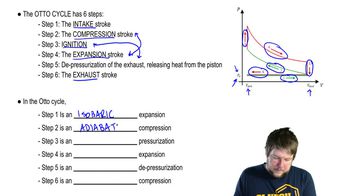
The Otto Cycle

Heat Input

Heat input refers to the total energy supplied to the engine from the fuel, which is necessary to produce the work output. To find the total heat input per second, one must consider both the work done and the efficiency of the engine. The formula used is: Heat Input = Work Output / Efficiency, allowing us to determine how much energy is needed from the gasoline to sustain the engine's operation.
Recommended video:
Guided course
05:14
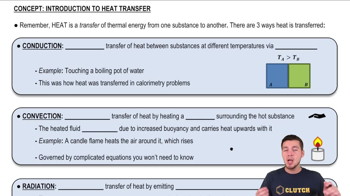
Overview of Heat Transfer