
Ch. 20 - Second Law of Thermodynamics
Giancoli Douglas - Physics for Scientists and Engineers 5th edition
Giancoli Douglas5th editionPhysics for Scientists and EngineersISBN: 9780137488179Not the one you use?Change textbook
Chapter 20, Problem 15

Assume that a 65-kg hiker needs to eat 4.0 x 10³ kcal of energy to supply a day’s worth of metabolism ( = QH). Estimate the elevation change the person can climb in one day, using only this amount of energy. As a fun and rough prediction, treat the person as an isolated heat engine, operating between the internal temperature of 37°C (98.6°F) and the ambient air temperature of 20°C.

Verified step by step guidance
1
Convert the given energy from kilocalories to joules. Use the conversion factor: 1 kcal = 4184 J. Multiply the given energy (4.0 × 10³ kcal) by 4184 J/kcal to find the total energy in joules.
Determine the efficiency of the hiker as a heat engine. Use the Carnot efficiency formula: η = 1 - (T_c / T_h), where T_c is the ambient air temperature and T_h is the internal body temperature. Convert both temperatures from Celsius to Kelvin by adding 273.15 to each value.
Calculate the useful work output (W) using the formula: W = η × Q_H, where Q_H is the total energy input (in joules) and η is the efficiency calculated in the previous step.
Relate the work output to the potential energy change due to elevation gain. Use the formula for gravitational potential energy: W = m × g × h, where m is the mass of the hiker (65 kg), g is the acceleration due to gravity (9.8 m/s²), and h is the elevation change. Rearrange the formula to solve for h: h = W / (m × g).
Substitute the values for W, m, and g into the formula for h to estimate the elevation change. Ensure all units are consistent, and simplify the expression to find the result.

Verified video answer for a similar problem:

This video solution was recommended by our tutors as helpful for the problem above.
Video duration:
9m
Was this helpful?

Key Concepts

Here are the essential concepts you must grasp in order to answer the question correctly.

Heat Engine Efficiency

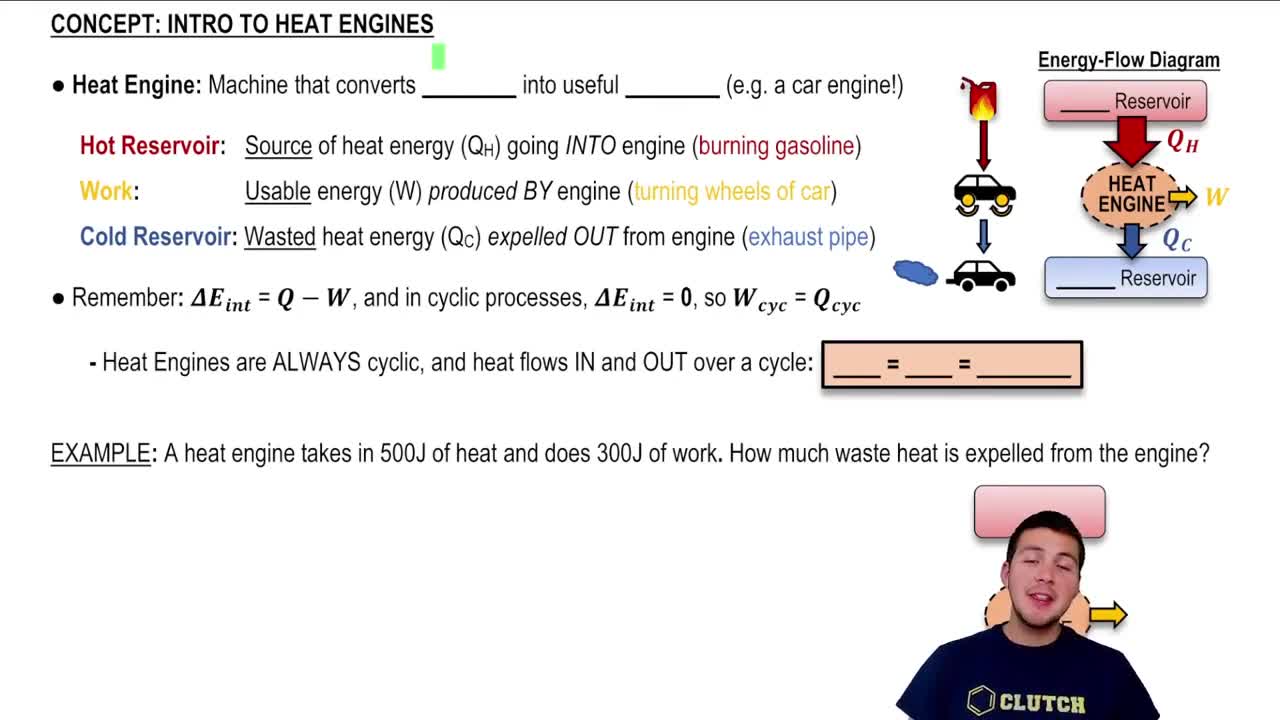
A heat engine converts thermal energy into mechanical work, and its efficiency is determined by the temperatures of the heat source and sink. The efficiency (η) can be calculated using the formula η = 1 - (T_cold/T_hot), where temperatures are in Kelvin. In this scenario, the hiker's body acts as a heat engine, with the internal body temperature as the heat source and the ambient temperature as the heat sink.
Recommended video:
Guided course
07:35
Introduction to Heat Engines

Work Done Against Gravity

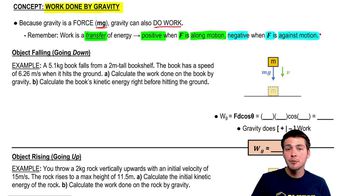
When a hiker climbs, they perform work against gravitational force, which can be calculated using the formula W = mgh, where W is work, m is mass, g is the acceleration due to gravity (approximately 9.81 m/s²), and h is the height gained. The energy available from metabolism can be converted into this work, allowing us to estimate the elevation change the hiker can achieve.
Recommended video:
Guided course
06:34
Work Done By Gravity

Conversion of Energy Units

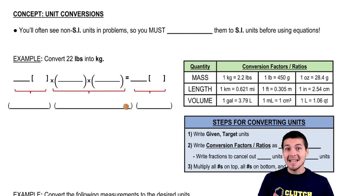
Energy is often measured in different units, and in this problem, we need to convert kilocalories (kcal) into joules (J) for consistency with the work formula. The conversion factor is 1 kcal = 4184 J. Understanding this conversion is crucial for accurately calculating the work done by the hiker based on the energy they can metabolize.
Recommended video:
Guided course
07:46
Unit Conversions