
A bowl contains many red, orange, and green jelly beans, in equal numbers. You are to make a line of 3 jelly beans by randomly taking 3 beans from the bowl. Construct a table showing the number of microstates that correspond to each macrostate.
Ch. 20 - Second Law of Thermodynamics
Giancoli Douglas5th editionPhysics for Scientists and EngineersISBN: 9780137488179Not the one you use?Change textbook
Chapter 20, Problem 93
Trees can help a bit to offset the buildup of CO₂ due to burning coal and other fossil fuels. CO₂ can be absorbed by tree foliage. Trees use the carbon to grow, and release O₂ into the atmosphere. Suppose a refrigerator uses 600 kWh of electricity per year (about 2 x 10⁹ J) from a 33% efficient coal-fired power plant. Burning 1 kg of coal releases about 2 x 10⁷ J of energy. Assume coal is all carbon, which when burned in air becomes CO₂.
(a) How much coal is burned per year to run this refrigerator?
(b) Assuming a forest can capture 1700 kg of carbon per hectare ( = 10, 000 m²) per year, estimate how many square meters of forest are needed to capture the carbon (in the form now of CO₂) emitted by the refrigerator in (a).
Verified step by step guidance1
Step 1: Calculate the total energy required to run the refrigerator for a year. The problem states that the refrigerator uses 600 kWh of electricity per year. Convert this to joules using the conversion factor: 1 kWh = 3.6 × 10⁶ J. Multiply 600 kWh by 3.6 × 10⁶ J/kWh to find the total energy in joules.
Step 2: Determine the energy input required from the coal-fired power plant. Since the power plant is 33% efficient, only 33% of the energy from burning coal is converted into electricity. Use the formula: Energy input = Energy output / Efficiency. Divide the total energy required by the refrigerator (from Step 1) by 0.33 to find the energy input from coal.
Step 3: Calculate the mass of coal burned. The problem states that burning 1 kg of coal releases 2 × 10⁷ J of energy. Use the formula: Mass of coal = Energy input / Energy per kg of coal. Divide the energy input (from Step 2) by 2 × 10⁷ J/kg to find the mass of coal burned per year.
Step 4: Determine the amount of carbon emitted. Since coal is assumed to be all carbon, the mass of coal burned (from Step 3) is equal to the mass of carbon emitted. Use this value to calculate the amount of carbon that needs to be captured by the forest.
Step 5: Calculate the area of forest required. The problem states that a forest can capture 1700 kg of carbon per hectare per year. Convert hectares to square meters (1 hectare = 10,000 m²). Use the formula: Area of forest = Mass of carbon emitted / Carbon capture rate per m². Divide the mass of carbon emitted (from Step 4) by the carbon capture rate (1700 kg/10,000 m²) to find the required forest area in square meters.

Verified video answer for a similar problem:
This video solution was recommended by our tutors as helpful for the problem above.
Video duration:
8mWas this helpful?
Key Concepts
Here are the essential concepts you must grasp in order to answer the question correctly.
Energy Efficiency
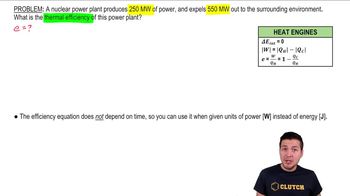
Energy efficiency refers to the ratio of useful output of a process to the input energy, often expressed as a percentage. In this context, the 33% efficiency of the coal-fired power plant indicates that only one-third of the energy from burning coal is converted into usable electricity, while the rest is lost as waste heat. Understanding this concept is crucial for calculating the total energy input required to power the refrigerator.
Recommended video:
Guided course
Efficiency of a Nuclear Power Plant
Carbon Emissions from Coal
When coal is burned, it primarily releases carbon dioxide (CO₂) as a byproduct of combustion. Each kilogram of coal produces approximately 20 million joules of energy and, when fully combusted, contributes to the atmospheric CO₂ levels. This concept is essential for determining how much coal is needed to generate the energy required by the refrigerator and understanding the environmental impact of fossil fuel consumption.
Recommended video:
Guided course
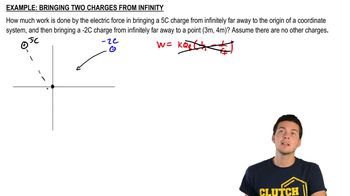
Work to Bring Two Charges From Infinity
Carbon Sequestration by Trees
Carbon sequestration is the process by which trees absorb CO₂ from the atmosphere and store carbon in their biomass. The ability of a forest to capture 1700 kg of carbon per hectare per year highlights the role of trees in mitigating climate change. This concept is vital for estimating the area of forest needed to offset the carbon emissions produced by the refrigerator, linking energy consumption to ecological solutions.
Recommended video:
Guided course
Moles & Avogadro's Number
Related Practice
Textbook Question
1
views
Textbook Question
A bowl contains many red, orange, and green jelly beans, in equal numbers. You are to make a line of 3 jelly beans by randomly taking 3 beans from the bowl. Construct a table showing the number of microstates that correspond to each macrostate. Then, determine the probability of all 3 beans red.
1
views
Textbook Question
Rank the following five-card hands in order of increasing probability: (a) four aces and a king; (b) six of hearts, eight of diamonds, queen of clubs, three of hearts, jack of spades; (c) two jacks, two queens, and an ace; and (d) any hand having no two equal-value cards (no pairs, etc.). Discuss your ranking in terms of microstates and macrostates.
1
views
