Ch. 20 - Second Law of Thermodynamics
Giancoli Douglas - Physics for Scientists and Engineers 5th edition
Giancoli Douglas5th editionPhysics for Scientists and EngineersISBN: 9780137488179Not the one you use?Change textbook
Chapter 20, Problem 20a

One mole of monatomic gas undergoes a Carnot cycle with TH = 350°C and TL = 210°C. The initial pressure is 8.8 atm. During the isothermal expansion, the volume doubles. Find the values of the pressure and volume at the points a, b, c, and d of Fig. 20–5.

Verified step by step guidance
1
Step 1: Convert the given temperatures from Celsius to Kelvin. Use the formula T(K) = T(°C) + 273.15. For T_H = 350°C, calculate T_H in Kelvin. Similarly, for T_L = 210°C, calculate T_L in Kelvin.
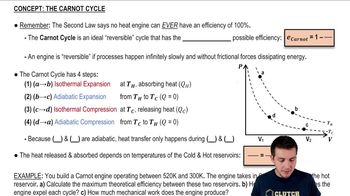
Step 2: Identify the key points in the Carnot cycle (a, b, c, d) and their corresponding processes: (a to b) isothermal expansion at T_H, (b to c) adiabatic expansion, (c to d) isothermal compression at T_L, and (d to a) adiabatic compression. Use the given information that the volume doubles during the isothermal expansion (a to b).
Step 3: For the isothermal expansion (a to b), use the ideal gas law, PV = nRT, to calculate the pressure at point b. Since the volume doubles, V_b = 2V_a. The temperature remains constant at T_H, so P_a * V_a = P_b * V_b. Solve for P_b.
Step 4: For the adiabatic expansion (b to c), use the adiabatic condition for a monatomic gas: P * V^(γ) = constant, where γ = 5/3 for a monatomic gas. Use the known values of P_b, V_b, and the relationship to find P_c and V_c. Note that the temperature at point c is T_L.
Step 5: For the isothermal compression (c to d) and adiabatic compression (d to a), repeat similar calculations. For the isothermal compression, use P_c * V_c = P_d * V_d, where the temperature is T_L. For the adiabatic compression, use the adiabatic condition again to find P_a and V_a, ensuring the cycle closes back to the initial state.

Verified video answer for a similar problem:

This video solution was recommended by our tutors as helpful for the problem above.
Video duration:
13m
Was this helpful?

Key Concepts

Here are the essential concepts you must grasp in order to answer the question correctly.

Carnot Cycle

The Carnot cycle is a theoretical thermodynamic cycle that provides the maximum possible efficiency for a heat engine operating between two temperature reservoirs. It consists of four reversible processes: two isothermal (constant temperature) and two adiabatic (no heat exchange). Understanding this cycle is crucial for analyzing the performance of real engines and calculating work done and heat transfer during the cycle.
Recommended video:
Guided course
06:28
The Carnot Cycle and Maximum Theoretical Efficiency

Ideal Gas Law

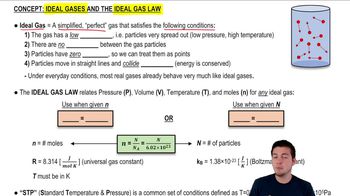
The Ideal Gas Law relates the pressure, volume, temperature, and number of moles of an ideal gas through the equation PV = nRT. In this context, it is essential for determining the state variables of the gas at different points in the Carnot cycle, especially during isothermal and adiabatic processes. This law allows us to calculate changes in pressure and volume as the gas undergoes transformations.
Recommended video:
Guided course
07:21
Ideal Gases and the Ideal Gas Law

Isothermal Process

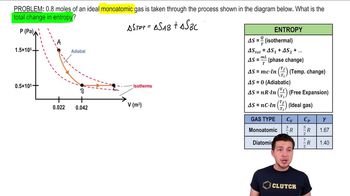
An isothermal process occurs at a constant temperature, meaning that any heat added to the system is used to do work rather than change the internal energy. For an ideal gas, this implies that the product of pressure and volume remains constant (PV = constant). In the context of the Carnot cycle, understanding isothermal expansion and compression is vital for calculating the work done and the changes in pressure and volume at specific points in the cycle.
Recommended video:
Guided course
06:13
Entropy & Ideal Gas Processes
Related Practice
Textbook Question

(II) What is the temperature inside an ideal refrigerator–freezer that operates with a COP = 7.0 in a 22°C room?

1
views

Textbook Question

One mole of monatomic gas undergoes a Carnot cycle with TH = 350°C and TL = 210°C. The initial pressure is 8.8 atm. During the isothermal expansion, the volume doubles. Calculate the efficiency of the cycle using Eqs. 20–1 and 20–3.

2
views
Textbook Question

(II) 1.00 mole of nitrogen (N₂) gas and 1.00 mole of argon (Ar) gas are in separate, equal-sized, insulated containers at the same temperature. The containers are then connected and the gases (assumed ideal) allowed to mix. What is the change in entropy

(a) of the system

1
views
Textbook Question

What is the coefficient of performance of an ideal heat pump that extracts heat from 6°C air outside and deposits heat inside a house at 24°C?

1
views
Textbook Question

The working substance of a certain Carnot engine is 1.0 mol of an ideal monatomic gas. During the isothermal expansion portion of this engine’s cycle, the volume of the gas doubles, while during the adiabatic expansion the volume increases by a factor of 6.2. The work output of the engine is 920 J in each cycle. Compute the temperatures of the two reservoirs between which this engine operates.

Textbook Question

A particular car does work at the rate of about 7.0 kJ/s when traveling at a steady 21.8 m/s along a level road. This is the work done against friction. The car can travel 17 km on 1.0 L of gasoline at this speed (about 40 mi/gal). What is the minimum value for TH if TL is 25°C? The energy available from 1.0 L of gas is 3.2 x 10⁷ J.

1
views