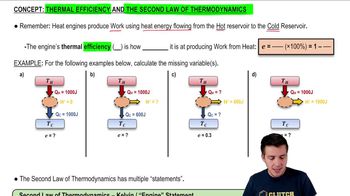
An ideal heat pump is used to maintain the inside temperature of a house at Tᵢₙ = 22°C when the outside temperature is Tₒᵤₜ. Assume the heat pump does work at a rate of 1700 W. Also assume that the house loses heat via conduction through its walls and other surfaces at a rate given by ( 650 W/C°) (Tᵢₙ - Tₒᵤₜ). If the outside temperature is less than you just calculated, what happens?
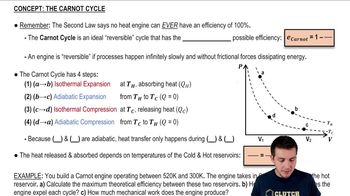
One mole of monatomic gas undergoes a Carnot cycle with TH = 350°C and TL = 210°C. The initial pressure is 8.8 atm. During the isothermal expansion, the volume doubles. Calculate the efficiency of the cycle using Eqs. 20–1 and 20–3.
Verified step by step guidance
Verified video answer for a similar problem:
Key Concepts
Carnot Cycle
Thermal Efficiency
Ideal Gas Law
(II) What is the temperature inside an ideal refrigerator–freezer that operates with a COP = 7.0 in a 22°C room?
One mole of monatomic gas undergoes a Carnot cycle with TH = 350°C and TL = 210°C. The initial pressure is 8.8 atm. During the isothermal expansion, the volume doubles. Find the values of the pressure and volume at the points a, b, c, and d of Fig. 20–5.
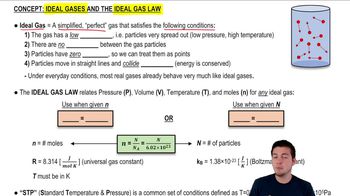
(II) 1.00 mole of nitrogen (N₂) gas and 1.00 mole of argon (Ar) gas are in separate, equal-sized, insulated containers at the same temperature. The containers are then connected and the gases (assumed ideal) allowed to mix. What is the change in entropy
(a) of the system
What is the coefficient of performance of an ideal heat pump that extracts heat from 6°C air outside and deposits heat inside a house at 24°C?
The working substance of a certain Carnot engine is 1.0 mol of an ideal monatomic gas. During the isothermal expansion portion of this engine’s cycle, the volume of the gas doubles, while during the adiabatic expansion the volume increases by a factor of 6.2. The work output of the engine is 920 J in each cycle. Compute the temperatures of the two reservoirs between which this engine operates.
