Ch. 20 - Second Law of Thermodynamics
Giancoli Douglas - Physics for Scientists and Engineers 5th edition
Giancoli Douglas5th editionPhysics for Scientists and EngineersISBN: 9780137488179Not the one you use?Change textbook
Chapter 20, Problem 29b

An ideal heat pump is used to maintain the inside temperature of a house at Tᵢₙ = 22°C when the outside temperature is Tₒᵤₜ. Assume the heat pump does work at a rate of 1700 W. Also assume that the house loses heat via conduction through its walls and other surfaces at a rate given by ( 650 W/C°) (Tᵢₙ - Tₒᵤₜ). If the outside temperature is less than you just calculated, what happens?

Verified step by step guidance
1
Step 1: Understand the problem. The heat pump is maintaining the inside temperature of the house at Tᵢₙ = 22°C, while the outside temperature is Tₒᵤₜ. The heat pump does work at a rate of 1700 W, and the house loses heat at a rate of (650 W/°C) × (Tᵢₙ - Tₒᵤₜ). We need to analyze what happens if the outside temperature is less than a certain value.
Step 2: Recall the efficiency of an ideal heat pump. The coefficient of performance (COP) for an ideal heat pump is given by: COP=Tin+273/(Tin+273-Tout). This formula relates the temperatures to the performance of the heat pump.
Step 3: Calculate the heat delivered by the heat pump. The heat delivered to the house, Qᵢₙ, is related to the work done by the heat pump, W, and the COP by the equation: Qin=COPW. Substitute the expression for COP from Step 2 into this equation.
Step 4: Set up the heat balance equation. The heat delivered by the heat pump, Qᵢₙ, must equal the heat lost by the house, which is given as (650 W/°C) × (Tᵢₙ - Tₒᵤₜ). Use this equality to solve for Tₒᵤₜ, the outside temperature.
Step 5: Analyze the situation if Tₒᵤₜ is less than the calculated value. If the outside temperature drops below the calculated Tₒᵤₜ, the heat pump will no longer be able to supply enough heat to balance the heat loss from the house. This means the inside temperature will start to drop, as the heat pump's capacity is insufficient to maintain Tᵢₙ = 22°C.

Verified video answer for a similar problem:

This video solution was recommended by our tutors as helpful for the problem above.
Video duration:
6m
Was this helpful?

Key Concepts

Here are the essential concepts you must grasp in order to answer the question correctly.

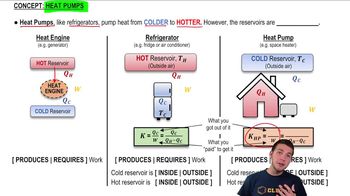
Heat Pump Operation

A heat pump transfers thermal energy from a colder area to a warmer area, using work input to move heat against its natural flow. It operates based on the principles of thermodynamics, specifically the refrigeration cycle, which involves the evaporation and condensation of a refrigerant. The efficiency of a heat pump is often measured by its Coefficient of Performance (COP), which indicates how much heat is moved per unit of work input.
Recommended video:

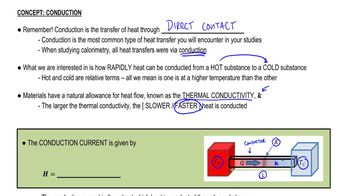
Heat Loss through Conduction

Heat loss through conduction refers to the transfer of thermal energy through materials due to a temperature difference. In this scenario, the rate of heat loss is quantified by the equation (650 W/°C)(Tᵢₙ - Tₒᵤₜ), where Tᵢₙ is the inside temperature and Tₒᵤₜ is the outside temperature. This concept is crucial for understanding how much energy the heat pump must compensate for to maintain the desired indoor temperature.
Recommended video:

Thermal Equilibrium

Thermal equilibrium occurs when two systems reach the same temperature, resulting in no net heat transfer between them. In the context of the heat pump, if the outside temperature drops significantly below the calculated threshold, the heat pump may struggle to maintain the indoor temperature, leading to a potential drop in indoor comfort. Understanding this concept helps predict the performance limits of the heat pump under varying external conditions.
Recommended video:
Guided course
05:21
Volume Thermal Expansion