
An ideal heat pump is used to maintain the inside temperature of a house at Tᵢₙ = 22°C when the outside temperature is Tₒᵤₜ. Assume the heat pump does work at a rate of 1700 W. Also assume that the house loses heat via conduction through its walls and other surfaces at a rate given by ( 650 W/C°) (Tᵢₙ - Tₒᵤₜ). If the outside temperature is less than you just calculated, what happens?
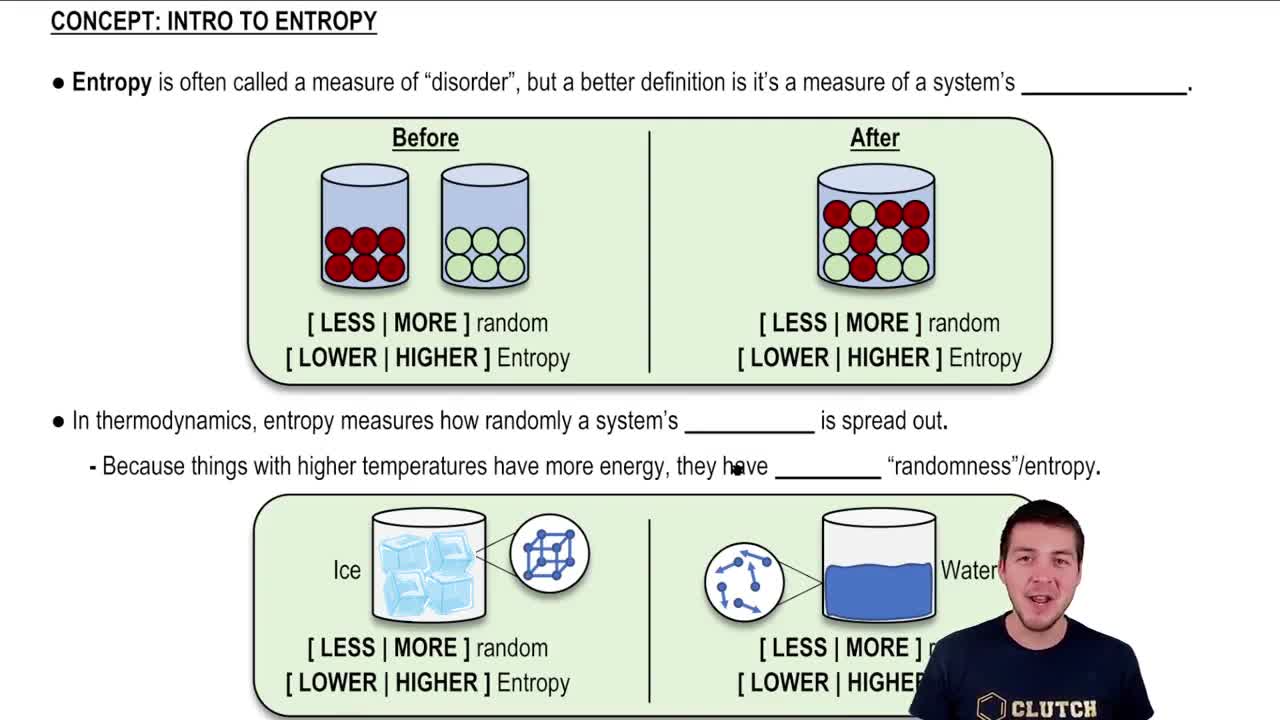
If 0.45 kg of water at 100°C is changed by a reversible process to steam at 100°C, determine the change in entropy of the surroundings.
Verified step by step guidance
Verified video answer for a similar problem:
Key Concepts
Entropy
Reversible Process
Surroundings
If 0.45 kg of water at 100°C is changed by a reversible process to steam at 100°C, determine the change in entropy of the water, the surroundings, and the universe as a whole. How would your answers differ if the process were irreversible?
Why would you expect the total entropy change in a Carnot cycle to be zero?
If 0.45 kg of water at 100°C is changed by a reversible process to steam at 100°C, determine the change in entropy of the universe as a whole.
What is the coefficient of performance of an ideal heat pump that extracts heat from 6°C air outside and deposits heat inside a house at 24°C?
How much less per year would it cost a family to operate a heat pump that has a coefficient of performance of 2.9 than an electric heater that costs \$2100 to heat their home for a year? If the conversion to the heat pump costs \$15,000, how long would it take the family to break even on heating costs? How much would the family save in 20 years?
