Ch. 20 - Second Law of Thermodynamics
Giancoli Douglas - Physics for Scientists and Engineers 5th edition
Giancoli Douglas5th editionPhysics for Scientists and EngineersISBN: 9780137488179Not the one you use?Change textbook
Chapter 20, Problem 38d

If 0.45 kg of water at 100°C is changed by a reversible process to steam at 100°C, determine the change in entropy of the water, the surroundings, and the universe as a whole. How would your answers differ if the process were irreversible?

Verified step by step guidance
1
Step 1: Understand the problem. The problem involves a phase change of water at constant temperature (100°C) from liquid to steam. This is an isothermal process, and the change in entropy (ΔS) can be calculated using the formula ΔS = Q/T, where Q is the heat added and T is the absolute temperature in kelvins.
Step 2: Calculate the heat added (Q). The heat required for the phase change is given by Q = mL, where m is the mass of the water (0.45 kg) and L is the latent heat of vaporization of water (approximately 2.26 × 10^6 J/kg). Substitute the values to find Q.
Step 3: Calculate the change in entropy of the water (ΔS_water). Use the formula ΔS = Q/T, where T is the absolute temperature in kelvins (100°C = 373 K). Substitute the value of Q from Step 2 and T = 373 K to find ΔS_water.
Step 4: Analyze the surroundings and the universe. For a reversible process, the heat lost by the surroundings is equal in magnitude but opposite in sign to the heat gained by the system. Therefore, the entropy change of the surroundings (ΔS_surroundings) is -Q/T. The total entropy change of the universe (ΔS_universe) is the sum of ΔS_water and ΔS_surroundings, which is zero for a reversible process.
Step 5: Consider the irreversible process. In an irreversible process, the entropy change of the system (ΔS_water) remains the same, but the entropy change of the surroundings (ΔS_surroundings) is not equal in magnitude to -Q/T. This results in a positive total entropy change for the universe (ΔS_universe > 0), reflecting the second law of thermodynamics.

Verified video answer for a similar problem:

This video solution was recommended by our tutors as helpful for the problem above.
Video duration:
8m
Was this helpful?

Key Concepts

Here are the essential concepts you must grasp in order to answer the question correctly.

Entropy

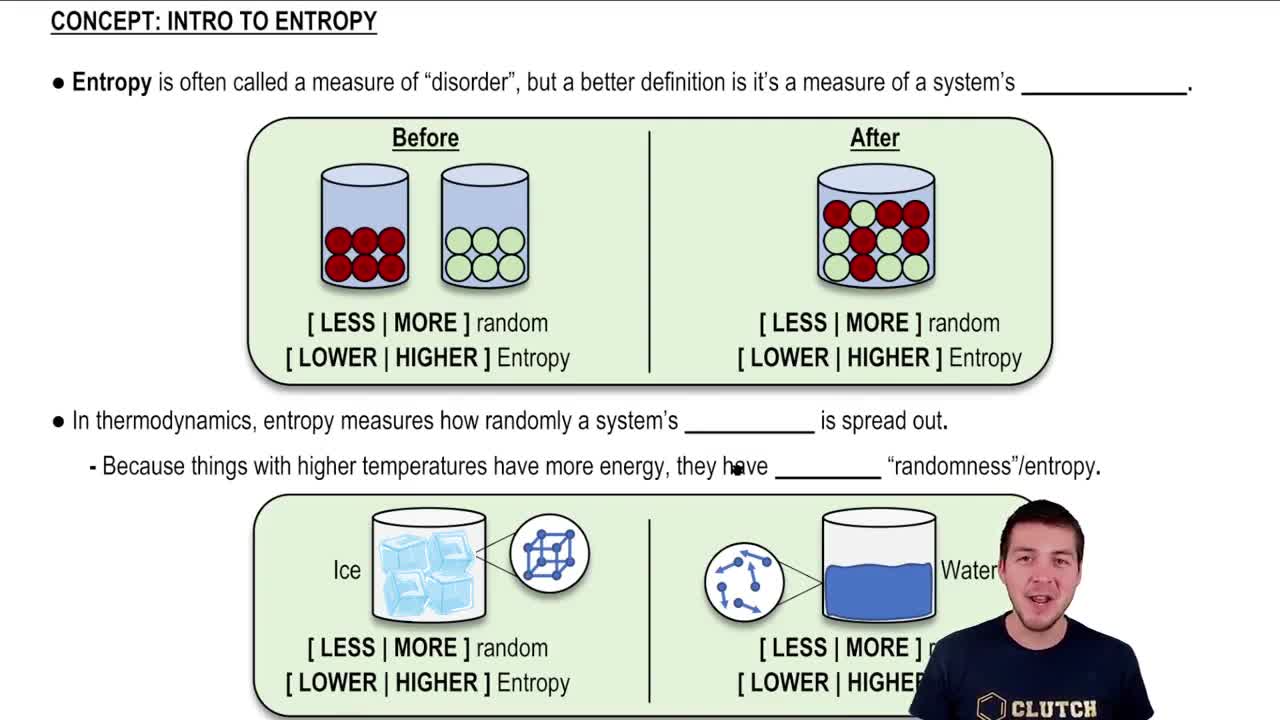
Entropy is a measure of the disorder or randomness in a system. In thermodynamics, it quantifies the amount of energy in a system that is not available to do work. When a substance undergoes a phase change, such as from water to steam, the entropy of the system changes, reflecting the increased disorder as molecules move from a liquid to a gaseous state.
Recommended video:
Guided course
07:50
Intro to Entropy

Reversible and Irreversible Processes

A reversible process is an idealized process that occurs in such a way that the system and surroundings can be returned to their original states without any net change. In contrast, an irreversible process cannot be reversed without leaving changes in the system and surroundings, often resulting in increased entropy. The distinction is crucial for calculating changes in entropy, as reversible processes yield maximum efficiency and minimum entropy change.
Recommended video:
Guided course
08:45
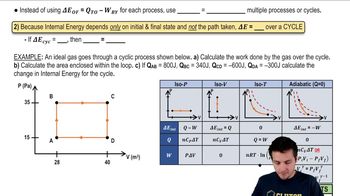
Properties of Cyclic Thermodynamic Processes

Surroundings and Universe in Thermodynamics

In thermodynamics, the surroundings refer to everything outside the system being studied, while the universe encompasses both the system and its surroundings. When analyzing entropy changes, it is essential to consider how energy is exchanged between the system and its surroundings, as this affects the overall entropy of the universe. The total change in entropy for the universe helps determine the spontaneity of a process.
Recommended video:
Guided course
08:04
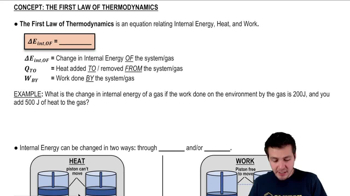
The First Law of Thermodynamics