Ch. 20 - Second Law of Thermodynamics
Giancoli Douglas - Physics for Scientists and Engineers 5th edition
Giancoli Douglas5th editionPhysics for Scientists and EngineersISBN: 9780137488179Not the one you use?Change textbook
Chapter 20, Problem 57a

A general theorem states that the amount of energy that becomes unavailable to do useful work in any process is equal to TL∆S, where TL is the lowest temperature available and ∆S is the total change in entropy during the process. Show that this is valid in the specific cases of a falling rock that comes to rest when it hits the ground.

Verified step by step guidance
1
Understand the problem: The goal is to show that the energy unavailable to do useful work, given by \( T_L \Delta S \), is valid for the specific case of a falling rock that comes to rest upon hitting the ground. Here, \( T_L \) is the lowest temperature available, and \( \Delta S \) is the total change in entropy during the process.
Analyze the system: When the rock falls, its gravitational potential energy is converted into kinetic energy. Upon hitting the ground, this kinetic energy is dissipated as heat and sound, increasing the entropy of the surroundings. The rock comes to rest, meaning all its initial energy is now unavailable for useful work.
Relate entropy change to energy dissipation: The heat energy \( Q \) transferred to the surroundings during the process is related to the entropy change \( \Delta S \) by \( \Delta S = \frac{Q}{T_L} \), where \( T_L \) is the temperature of the surroundings (assumed constant).
Express the unavailable energy: Rearrange the entropy equation to express the heat energy as \( Q = T_L \Delta S \). This heat energy represents the amount of energy that becomes unavailable to do useful work, as it is dissipated into the surroundings.
Conclude the proof: The expression \( T_L \Delta S \) is consistent with the general theorem for the specific case of the falling rock. The gravitational potential energy of the rock is entirely converted into heat energy, which increases the entropy of the surroundings, making \( T_L \Delta S \) the correct measure of unavailable energy.

Verified video answer for a similar problem:

This video solution was recommended by our tutors as helpful for the problem above.
Video duration:
6m
Was this helpful?

Key Concepts

Here are the essential concepts you must grasp in order to answer the question correctly.

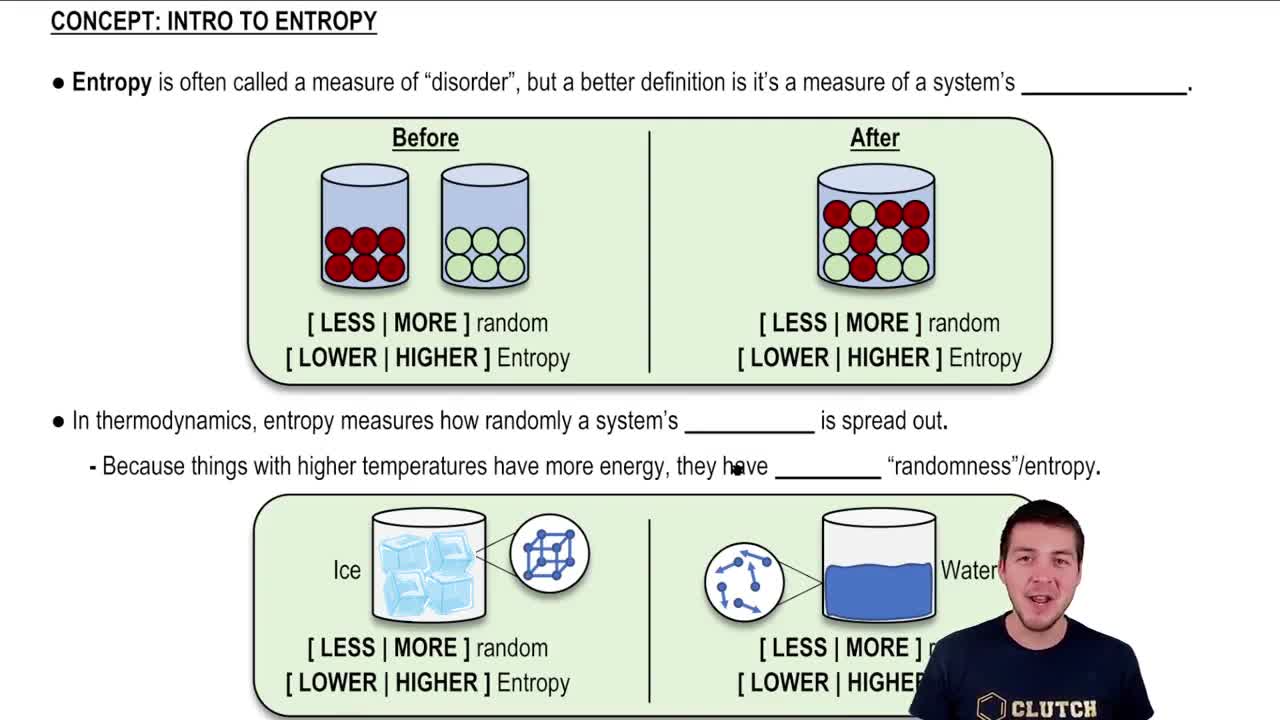
Entropy

Entropy is a measure of the disorder or randomness in a system. In thermodynamics, it quantifies the amount of energy in a physical system that is not available to do work. The second law of thermodynamics states that the total entropy of an isolated system can never decrease over time, which implies that processes tend to move towards a state of greater disorder.
Recommended video:
Guided course
07:50
Intro to Entropy

Thermal Energy and Temperature

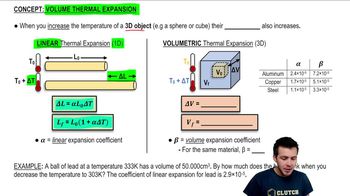
Thermal energy refers to the internal energy present in a system due to its temperature, which is a measure of the average kinetic energy of the particles in that system. The lowest temperature available, denoted as T_L, is crucial in determining the energy that cannot be converted into work. In the context of the theorem, it represents the baseline temperature at which energy transitions become less efficient.
Recommended video:
Guided course
05:21
Volume Thermal Expansion

Work and Energy Conservation

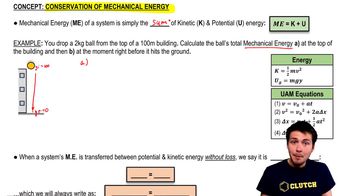
Work is defined as the energy transferred to or from an object via the application of force along a displacement. The principle of energy conservation states that energy cannot be created or destroyed, only transformed from one form to another. In the case of the falling rock, when it hits the ground, its kinetic energy is transformed into other forms, such as sound and heat, illustrating the conversion of energy and the unavailability of some energy to do further work.
Recommended video:
Guided course
06:24
Conservation Of Mechanical Energy