Ch. 20 - Second Law of Thermodynamics
Giancoli Douglas - Physics for Scientists and Engineers 5th edition
Giancoli Douglas5th editionPhysics for Scientists and EngineersISBN: 9780137488179Not the one you use?Change textbook
Chapter 20, Problem 59

Use Eq. 20–14 to determine the entropy of each of the five macrostates listed in Table 20–1 on page 595.

Verified step by step guidance
1
Identify the equation for entropy given in Eq. 20–14: \( S = k_B \ln W \), where \( S \) is the entropy, \( k_B \) is the Boltzmann constant, and \( W \) is the number of microstates corresponding to a macrostate.
Refer to Table 20–1 on page 595 to extract the values of \( W \) (the number of microstates) for each of the five macrostates.
For each macrostate, substitute the corresponding \( W \) value into the equation \( S = k_B \ln W \). Ensure that the natural logarithm (\( \ln \)) is used.
Multiply the result of \( \ln W \) by the Boltzmann constant \( k_B \) (approximately \( 1.38 \times 10^{-23} \, \text{J/K} \)) to calculate the entropy for each macrostate.
Repeat the calculation for all five macrostates and organize the results in a table or list for clarity.

Verified video answer for a similar problem:

This video solution was recommended by our tutors as helpful for the problem above.
Video duration:
6m
Was this helpful?

Key Concepts

Here are the essential concepts you must grasp in order to answer the question correctly.

Entropy

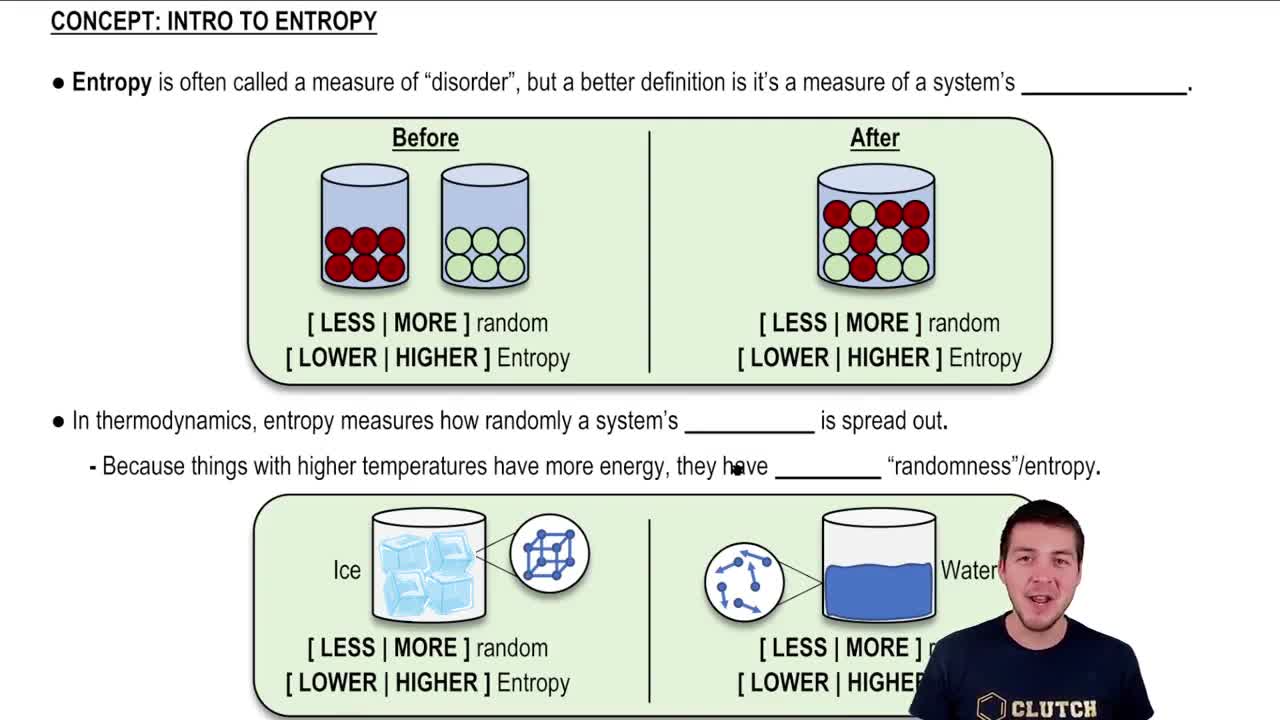
Entropy is a measure of the disorder or randomness in a system. In thermodynamics, it quantifies the number of microscopic configurations that correspond to a thermodynamic system's macroscopic state. Higher entropy indicates greater disorder and a higher number of possible configurations, while lower entropy suggests more order and fewer configurations.
Recommended video:
Guided course
07:50
Intro to Entropy

Macrostates and Microstates

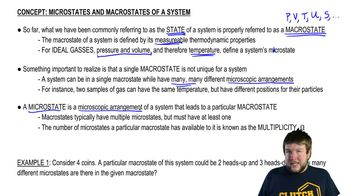
In statistical mechanics, a macrostate is defined by macroscopic properties such as temperature, pressure, and volume, while microstates are the specific detailed arrangements of particles that correspond to a macrostate. The relationship between macrostates and microstates is crucial for calculating entropy, as entropy is related to the number of microstates associated with a given macrostate.
Recommended video:
Guided course
06:41
Microstates and Macrostates of a System

Statistical Mechanics

Statistical mechanics is a branch of physics that uses statistical methods to explain and predict the thermodynamic properties of systems composed of a large number of particles. It connects microscopic behavior (individual particles) to macroscopic phenomena (bulk properties), allowing for the calculation of quantities like entropy and temperature based on particle statistics.
Recommended video:
Guided course
06:24
Conservation Of Mechanical Energy