
Ch. 19 - Heat and the First Law of Thermodynamics
Giancoli Douglas - Physics for Scientists and Engineers 5th edition
Giancoli Douglas5th editionPhysics for Scientists and EngineersISBN: 9780137488179Not the one you use?Change textbook
Chapter 19, Problem 75

(a) Estimate the total power radiated into space by the Sun, assuming it to be a perfect emitter at T = 5500 K. The Sun’s radius is 7.0 x 10⁸ m.
(b) From this, determine the power per unit area arriving at the Earth, 1.5 x 10¹¹ m away (Fig. 19–37).
Diagram showing the Sun and Earth with a distance of 1.5 x 10¹¹ m labeled between them.

Verified step by step guidance
1
Step 1: Use the Stefan-Boltzmann law to calculate the total power radiated by the Sun. The Stefan-Boltzmann law is given by: \( P = \sigma A T^4 \), where \( \sigma \) is the Stefan-Boltzmann constant \( (5.67 \times 10^{-8} \ \text{W/m}^2\text{K}^4) \), \( A \) is the surface area of the Sun, and \( T \) is the temperature of the Sun. The surface area of a sphere is \( A = 4 \pi R^2 \), where \( R \) is the radius of the Sun.
Step 2: Substitute the given values into the Stefan-Boltzmann law. The radius of the Sun is \( R = 7.0 \times 10^8 \ \text{m} \) and the temperature is \( T = 5500 \ \text{K} \). First, calculate the surface area \( A = 4 \pi (7.0 \times 10^8)^2 \). Then, substitute \( A \) and \( T \) into \( P = \sigma A T^4 \) to find the total power radiated by the Sun.
Step 3: To determine the power per unit area arriving at the Earth, use the inverse square law for radiation. The power per unit area \( S \) at a distance \( d \) from the source is given by \( S = \frac{P}{4 \pi d^2} \), where \( P \) is the total power radiated by the Sun and \( d \) is the distance from the Sun to the Earth.
Step 4: Substitute the values into the inverse square law. The distance from the Sun to the Earth is \( d = 1.5 \times 10^{11} \ \text{m} \). Use the total power \( P \) calculated in Step 2 and substitute it into \( S = \frac{P}{4 \pi (1.5 \times 10^{11})^2} \) to find the power per unit area arriving at the Earth.
Step 5: Simplify the expression for \( S \) to find the power per unit area. This value represents the solar constant, which is the amount of solar energy received per unit area at the Earth's distance from the Sun.

Verified video answer for a similar problem:

This video solution was recommended by our tutors as helpful for the problem above.
Video duration:
6m
Was this helpful?

Key Concepts

Here are the essential concepts you must grasp in order to answer the question correctly.

Stefan-Boltzmann Law

The Stefan-Boltzmann Law states that the total energy radiated per unit surface area of a black body is proportional to the fourth power of its absolute temperature (T). Mathematically, it is expressed as P = σT⁴, where P is the power per unit area, σ is the Stefan-Boltzmann constant (approximately 5.67 x 10⁻⁸ W/m²K⁴), and T is the temperature in Kelvin. This law is crucial for estimating the total power output of the Sun based on its surface temperature.
Recommended video:

Surface Area of a Sphere

The surface area of a sphere is calculated using the formula A = 4πr², where r is the radius of the sphere. In the context of the Sun, this formula allows us to determine the total area from which the Sun radiates energy. By calculating the surface area, we can then apply the Stefan-Boltzmann Law to find the total power emitted by the Sun.
Recommended video:
Guided course
09:18
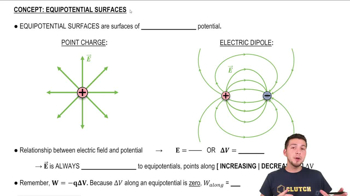
Equipotential Surfaces

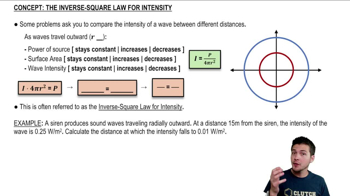
Inverse Square Law

The Inverse Square Law states that the intensity of a physical quantity (like light or radiation) decreases with the square of the distance from the source. For the Sun, this means that as the distance from the Sun increases, the power per unit area (or intensity) arriving at a point, such as Earth, is given by I = P/(4πd²), where P is the total power emitted and d is the distance from the Sun. This concept is essential for calculating how much solar power reaches the Earth.
Recommended video:
Guided course
05:26
The Inverse-Square Law for Intensity
Related Practice
Textbook Question

The temperature within the Earth’s crust increases about 1.0 C° for each 30 m of depth. The thermal conductivity of the crust is 0.80 J/s C°. Determine the heat transferred from the interior to the surface for the entire Earth in 1.0 h.

Textbook Question

What will be the final result when equal masses of ice at 0°C and steam at 100°C are mixed together?

1
views
Textbook Question

Show, using Eqs. 19–7 and 19–16, that the work done by a gas that slowly expands adiabatically from pressure P₁ and volume V₁ , to P₂ and V₂, is given by W = (P₁V₁ - P₂V₂) / (γ - 1).

1
views
Textbook Question

A microwave oven is used to heat 250 g of water. On its maximum setting, the oven can raise the temperature of the liquid water from 20°C to 100°C in 1 min 45 s ( = 105 s).

(a) At what rate does the oven put energy into the liquid water?

(b) If the power input from the oven to the water remains constant, determine how many grams of water will boil away if the oven is operated for 2 min (rather than just 1 min 45 s).

1
views
Textbook Question

A ceramic teapot (e = 0.70) and a shiny metal one (e = 0.10) each hold 0.55 L of tea at 85°C. (a) Estimate the rate of heat loss from each, and (b) estimate the temperature drop after 30 min for each. Consider only radiation, and assume the surroundings are at 20°C.

1
views
Textbook Question

A copper rod and an aluminum rod of the same length and cross-sectional area are attached end to end (Fig. 19–35). The copper end is placed in a furnace maintained at a constant temperature of 205°C. The aluminum end is placed in an ice bath held at a constant temperature of 0.0°C. Calculate the temperature at the point where the two rods are joined.

1
views