
Ch. 19 - Heat and the First Law of Thermodynamics
Giancoli Douglas - Physics for Scientists and Engineers 5th edition
Giancoli Douglas5th editionPhysics for Scientists and EngineersISBN: 9780137488179Not the one you use?Change textbook
Chapter 19, Problem 59

Show, using Eqs. 19–7 and 19–16, that the work done by a gas that slowly expands adiabatically from pressure P₁ and volume V₁ , to P₂ and V₂, is given by W = (P₁V₁ - P₂V₂) / (γ - 1).

Verified step by step guidance
1
Start by recalling the definition of an adiabatic process. In an adiabatic process, no heat is exchanged with the surroundings (Q = 0). The first law of thermodynamics, ΔU = Q - W, simplifies to ΔU = -W, where W is the work done by the gas and ΔU is the change in internal energy.
Use Eq. 19-7, which states that for an adiabatic process, the pressure and volume are related by P * V^γ = constant, where γ (gamma) is the adiabatic index (the ratio of specific heats, C_p/C_v). This means P₁ * V₁^γ = P₂ * V₂^γ.
The work done by the gas during an infinitesimal expansion or compression is given by dW = -P dV. To find the total work, integrate this expression over the volume change from V₁ to V₂. Substituting P from Eq. 19-7, P = (P₁ * V₁^γ) / V^γ, into the work equation gives W = -∫(P₁ * V₁^γ / V^γ) dV, with limits of integration from V₁ to V₂.
Simplify the integral by factoring out constants and integrating V^(1-γ). The integral becomes W = -(P₁ * V₁^γ) ∫(V^(1-γ)) dV, with limits from V₁ to V₂. The result of this integral is [(V^(2-γ)) / (2-γ)], evaluated from V₁ to V₂. Substitute the limits and simplify.
Finally, use the relationship γ = C_p / C_v to simplify the expression further. After simplification, the work done by the gas is W = (P₁V₁ - P₂V₂) / (γ - 1), as required. This result shows that the work depends on the initial and final states of the gas and the adiabatic index γ.

Verified video answer for a similar problem:

This video solution was recommended by our tutors as helpful for the problem above.
Video duration:
7m
Was this helpful?

Key Concepts

Here are the essential concepts you must grasp in order to answer the question correctly.

Adiabatic Process

An adiabatic process is one in which no heat is exchanged with the surroundings. In thermodynamics, this means that all the work done on or by the system results in a change in internal energy. For an ideal gas, this process can be described using specific equations that relate pressure, volume, and temperature, which are crucial for deriving work done during expansion or compression.
Recommended video:
Guided course
06:13
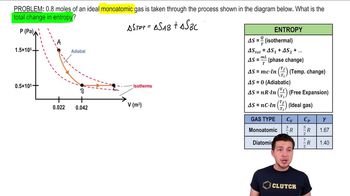
Entropy & Ideal Gas Processes

Work Done by a Gas

The work done by a gas during expansion or compression can be calculated using the integral of pressure with respect to volume. In the context of an adiabatic process, this work is related to the change in internal energy and can be expressed in terms of initial and final pressures and volumes. Understanding this relationship is essential for deriving the formula for work done in the given problem.
Recommended video:
Guided course
03:47
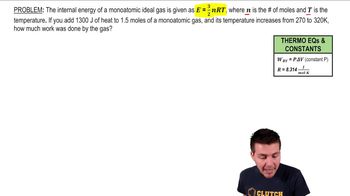
Calculating Work Done on Monoatomic Gas

Specific Heat Ratio (γ)

The specific heat ratio, denoted as γ (gamma), is the ratio of the specific heat at constant pressure (Cₚ) to the specific heat at constant volume (Cᵥ). This dimensionless quantity plays a critical role in characterizing the behavior of gases during adiabatic processes. It influences the relationship between pressure, volume, and temperature, and is key to deriving the work done by the gas in the expansion described in the question.
Recommended video:
Guided course
06:50
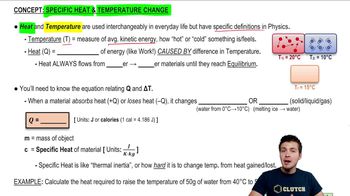
Specific Heat & Temperature Changes
Related Practice
Textbook Question

(a) Estimate the total power radiated into space by the Sun, assuming it to be a perfect emitter at T = 5500 K. The Sun’s radius is 7.0 x 10⁸ m.

(b) From this, determine the power per unit area arriving at the Earth, 1.5 x 10¹¹ m away (Fig. 19–37).

3
views
Textbook Question

If a heater supplies 1.8 x 10⁶ J/h to a room 3.5 m x 4.6 m x 3.0 m containing air at 20°C and 1.0 atm, by how much will the temperature rise in one hour, assuming no losses of heat or air mass to the outside? Assume air is an ideal diatomic gas with molecular mass 29.

2
views
Textbook Question

A ceramic teapot (e = 0.70) and a shiny metal one (e = 0.10) each hold 0.55 L of tea at 85°C. (a) Estimate the rate of heat loss from each, and (b) estimate the temperature drop after 30 min for each. Consider only radiation, and assume the surroundings are at 20°C.

1
views
Textbook Question

A 1.0-L volume of air initially at 3.5 atm of (gauge)pressure is allowed to expand isothermally until the (gauge) pressure is 1.0 atm. It is then compressed at constant pressure to its initial volume, and lastly is brought back to its original pressure by heating at constant volume. How much work does the 1.0 L of air do in this process?

Textbook Question

A copper rod and an aluminum rod of the same length and cross-sectional area are attached end to end (Fig. 19–35). The copper end is placed in a furnace maintained at a constant temperature of 205°C. The aluminum end is placed in an ice bath held at a constant temperature of 0.0°C. Calculate the temperature at the point where the two rods are joined.

1
views